
Running a Sex Offender Check in Iowa
The Iowa Sex Offender Registry is Iowa's central state repository for public registration data under Iowa Code chapter 692A. Iowa DCI administers Iowa's system. Iowa county sheriffs perform the local work: in-person registration, identity and address verification, change reporting, compliance checks, and additional inquiries allowed by law. Iowa DOC registers covered people before release from correctional custody. Iowa's public portal then provides the combined statewide view.
A result is not a full criminal history. It shows a current public registration obligation and selected information authorized for release. The underlying judgment remains with the court. DCI criminal history is a separate record. Some people who once had a qualifying case may be absent because their term ended, a court modified the duty, a conviction was reversed, they left Iowa, they are incarcerated, they died, or juvenile rules changed. Confirm both identity and present status before relying on an Iowa sex offender search.
Iowa Redesigned Its Registry Search
Iowa DPS relaunched the Iowa registry site in August 2025 with expanded search choices, interactive maps, active and most-wanted links, and clearer ways to search public data. Access to Iowa search results and full profiles passes through a public notice, user agreement, and reCAPTCHA.
The official Iowa Sex Offender Registry is the direct starting point for a statewide search.
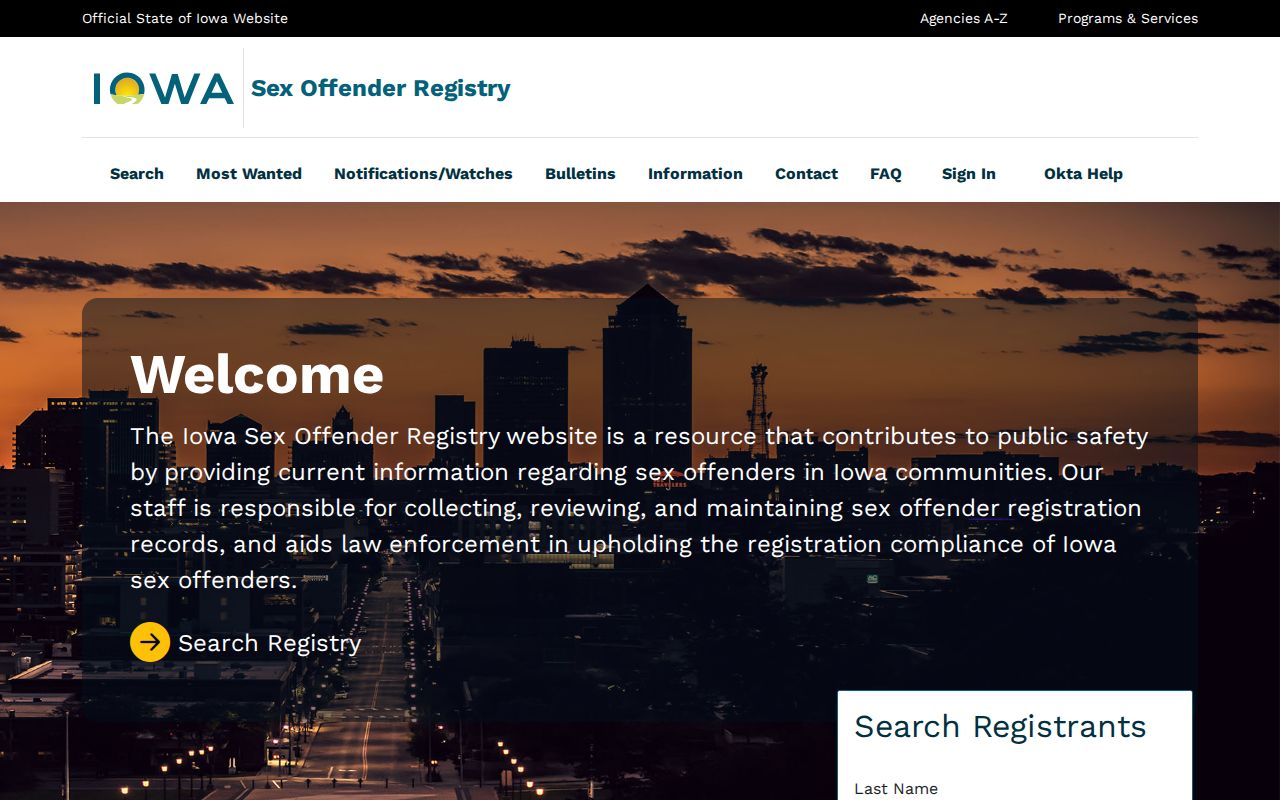
The redesigned interface supports name, map, advanced, telephone, and email searches, each answering a different type of registry question.
On August 11, 2026, the live site reported 7,144 active registrants. Its geographic statistics listed 6,757 people with a primary residential address in Iowa counties and 387 in an "Other" group, which includes outside-Iowa and unconfirmed locations.
Note: Iowa registry totals are dated snapshots; a current search and the county sheriff remain the better sources for present status.
How to Search the Iowa Sex Offender Registry
Use the narrowest facts known, then broaden only when needed. A common name can return several people, while a spelling variation or alias can hide the expected match. A profile should be checked by several identity fields before any conclusion.
- Open the official Iowa registry. Accept the public notice and complete the access check rather than using a copied or cached list.
- Choose the Iowa search mode. Enter a name and aliases, or use address, city, county, ZIP, and a numeric range for a place search.
- Confirm the Iowa profile. Compare the photograph, date of birth, physical description, aliases, registry number, address, and conviction details.
- Use the right fallback. Ask the Iowa county sheriff about a specific person or county list when the public site does not resolve the question.
| Field Label | Type | Required | Notes |
|---|---|---|---|
| First and Last Name | Text | No | Starts-with matching; alias search can be added |
| ISOR or OCI Number | Numeric text | No | Direct registry identifier |
| County, City, or ZIP | Dropdown or text | No | All 99 counties; nearby city or ZIP options may be included |
| Age, Height, Weight, Gender | Number or selection | No | Age uses a three-year range; height and weight use documented tolerances |
| Address and Range | Map controls | Conditional | A numeric mile range is required for a location search |
| Email Watches | Account signup | No | Saved alerts use an Iowa Okta account |
The Iowa registry's official feed specification confirms the search criteria and result behavior behind the public tools.
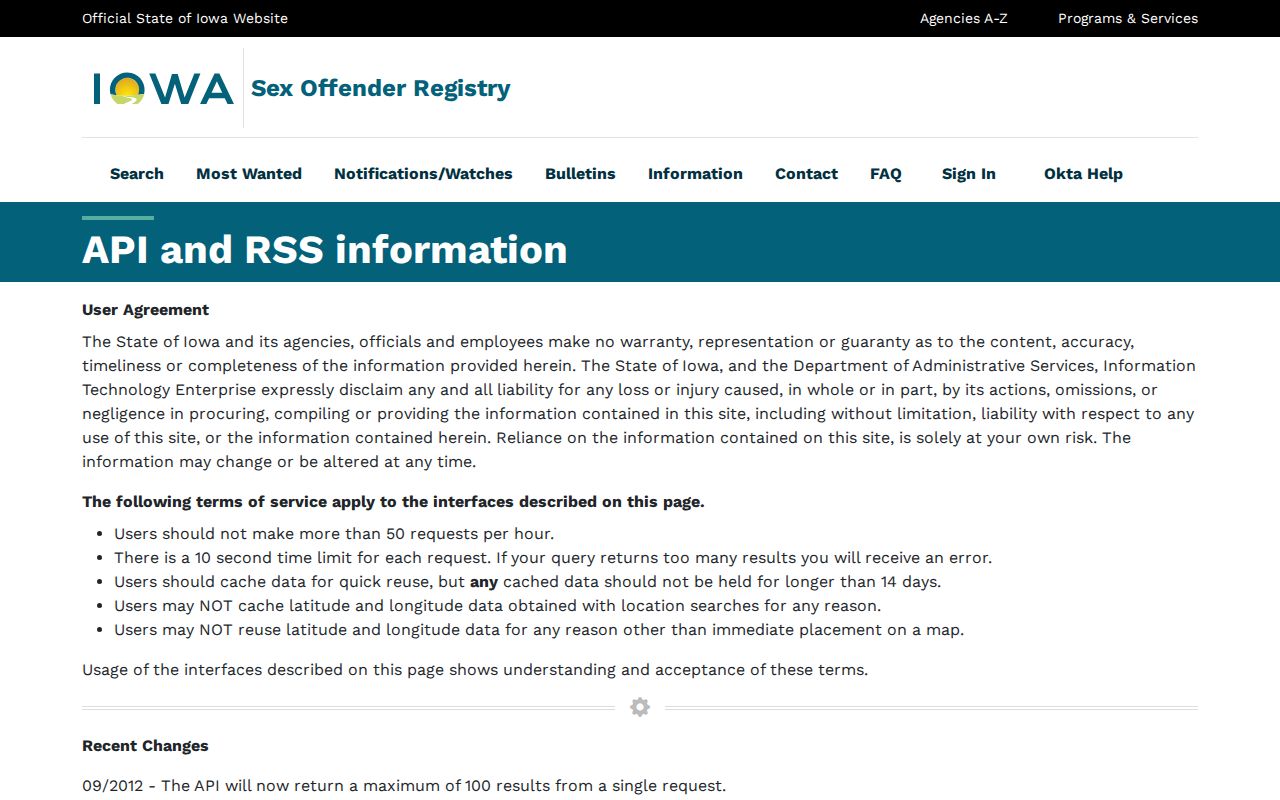
The field specification also documents paging, result limits, and location rules, which helps explain why broad and narrow searches may display different details.
Iowa Registry Results Have Limits
The Iowa registry user agreement says the public website does not contain the entire list of people registered in Iowa. Iowa sheriffs and local law enforcement know the subjects in their communities. An Iowa no-result search therefore does not prove that no conviction or prior registration exists. The person's registration may have ended or changed, the public display may be limited, or the search terms may not match current data.
Timing also matters. The home page has described updates as typically hourly on weekday business days, while other official text has said daily and sometimes as often as every 30 minutes on weekdays excluding holidays. Preserve that uncertainty. A recent move or report may be in process.
A missing profile is not a clearance. Try aliases and advanced fields, then use the sheriff route or source court record for a specific unresolved question.
Inside a Registry Profile
An Iowa registry profile combines identity, location, classification, compliance, and conviction fields. The Iowa profile is still a statutory public subset. Victim identities, fingerprints, palm prints, DNA, Social Security numbers, government identity documents, and other protected material are not public through the Iowa site.
| Name and Aliases | Display name, alternate names, registry ID, OCI or ISOR number, and date of birth. |
|---|---|
| Photograph and Description | Current or historical photos, sex, race, skin tone, hair, eyes, height, weight, and listed marks or tattoos. |
| Registered Location | Residence, city, state, ZIP, county, map point, distance, and same-location cluster count when published. |
| Conviction Details | Offense, Iowa Code citation, conviction date and county, age at offense, and limited victim categories without identities. |
| Tier and Review | Tier I, II, or III, verification schedule, residency or exclusion flags, and last-change time. |
| Compliance Status | Wanted or noncompliance status and whereabouts-unconfirmed information when applicable. |
Note: "Most Wanted" means noncompliance plus an active warrant; "whereabouts unconfirmed" means the registered address is no longer confirmed.
Iowa Registry Reporting Now Takes Three Days
Iowa Acts chapter 1079 took effect July 1, 2026 and shortened several Iowa registry reporting deadlines from five business days to three. A covered person must generally appear in person at the Iowa sheriff in each county of residence, work, or school within three business days of becoming required to register. Residence, work, and student-status changes use the same current deadline. Iowa law also addresses notice of other relevant changes.
Some inspected 2026 Iowa code and FAQ text still showed the old five-day period. The signed act controls the change, so older summaries should not be repeated as current. The new section 692A.105A also requires timely in-person reporting of work-location contact facts and vehicle details. These are duties the registrant reports to the Iowa sheriff, not a reason to assume every such field appears on a public profile.
The current Iowa Code chapter 692A source gathers the statutory registry framework in one official location.
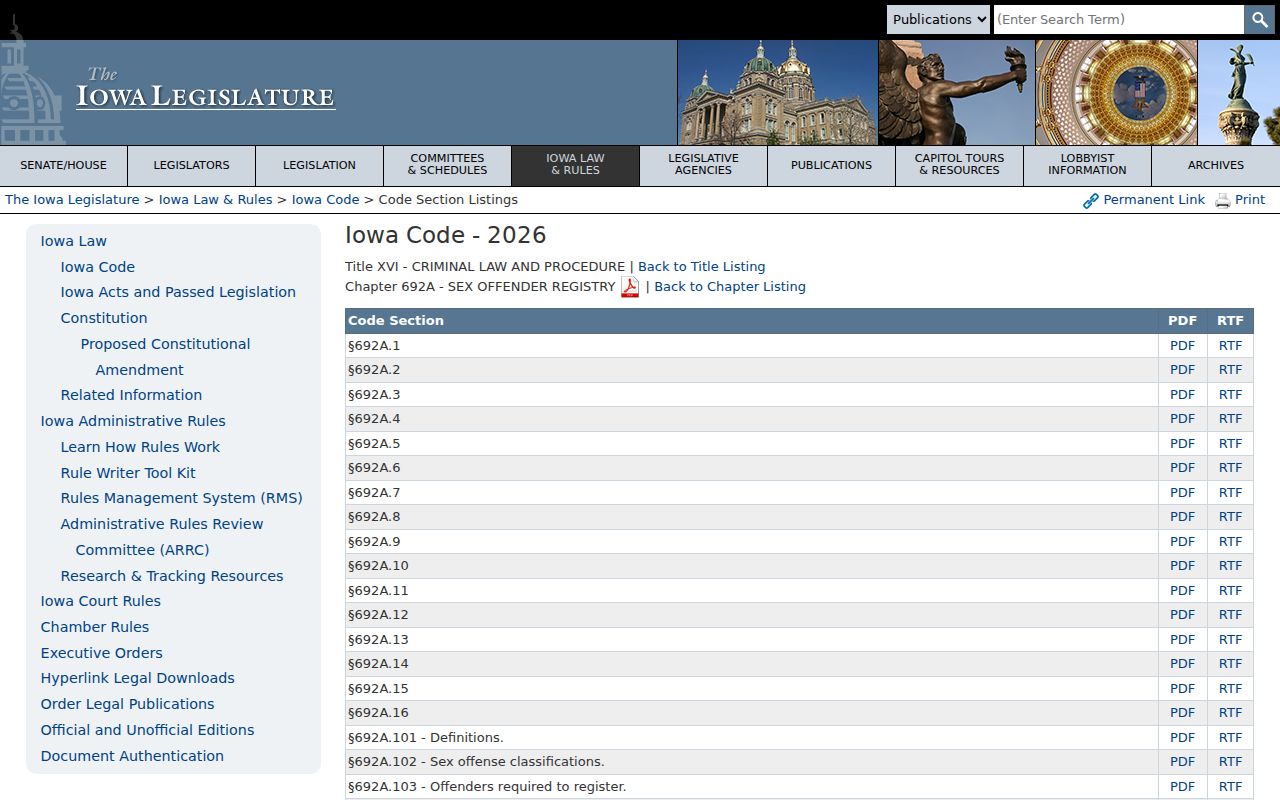
The chapter should be read with the signed 2026 act when a displayed code page has not yet caught up with the three-business-day amendment.
Note: The signed 2026 act controls Iowa's three-business-day deadline when an older official summary still displays five business days.
Iowa Registration Requirements and Levels
Iowa's Tier I, Tier II, and Tier III labels are based on the qualifying offense and statutory rules. They are not a simple low, medium, or high prediction of future conduct. The tier controls how often the person reports for in-person verification. Duration is a separate legal question affected by the offense, special sentence, repeat or aggravated triggers, tolling, compliance, and any court-approved modification.
| Level or Trigger | Duration | Verification Frequency |
|---|---|---|
| Tier I | Ordinarily at least 10 years, subject to statutory changes | Annually |
| Tier II | Determined under section 692A.106; no generic federal 25-year rule should be imported | Every six months |
| Tier III | Statutory baseline unless a special or lifetime trigger applies | Every three months |
| Repeat, aggravated, or lifetime-special-sentence trigger | Life when the specified statute applies | Frequency of the resulting tier |
| Ten-year special sentence | At least ten years as applicable | Frequency of the resulting tier |
At verification, the Iowa sheriff confirms relevant information and takes a photograph. Time may toll during incarceration or noncompliance. Revocation of probation, parole, or work release can restart the period after release. An Iowa registry-law conviction can add ten years to the otherwise scheduled end.
Iowa Sheriffs Fill Registry Gaps
Iowa Code section 692A.121 allows a person to ask an Iowa county sheriff by phone, in writing, or in person about a specific registrant. The request must give the name and at least one more identifier, such as date of birth, address, internet identifier, phone number, or Social Security number. The Iowa sheriff may provide public-site data plus school, temporary-lodging, and vehicle information authorized for that qualified inquiry. No fee may be charged.
An Iowa sheriff must also permit access on request to the full list of registrants in that county. Confidential victim identities, biometrics, protected identity documents, and other restricted data remain confidential. Use the Iowa county directory to reach the sheriff who handles the relevant location. That route is essential when an Iowa public search fails or when the question concerns the complete county list.
The official Iowa Registry contact channel provides a statewide route for comments or tips that are not emergencies.
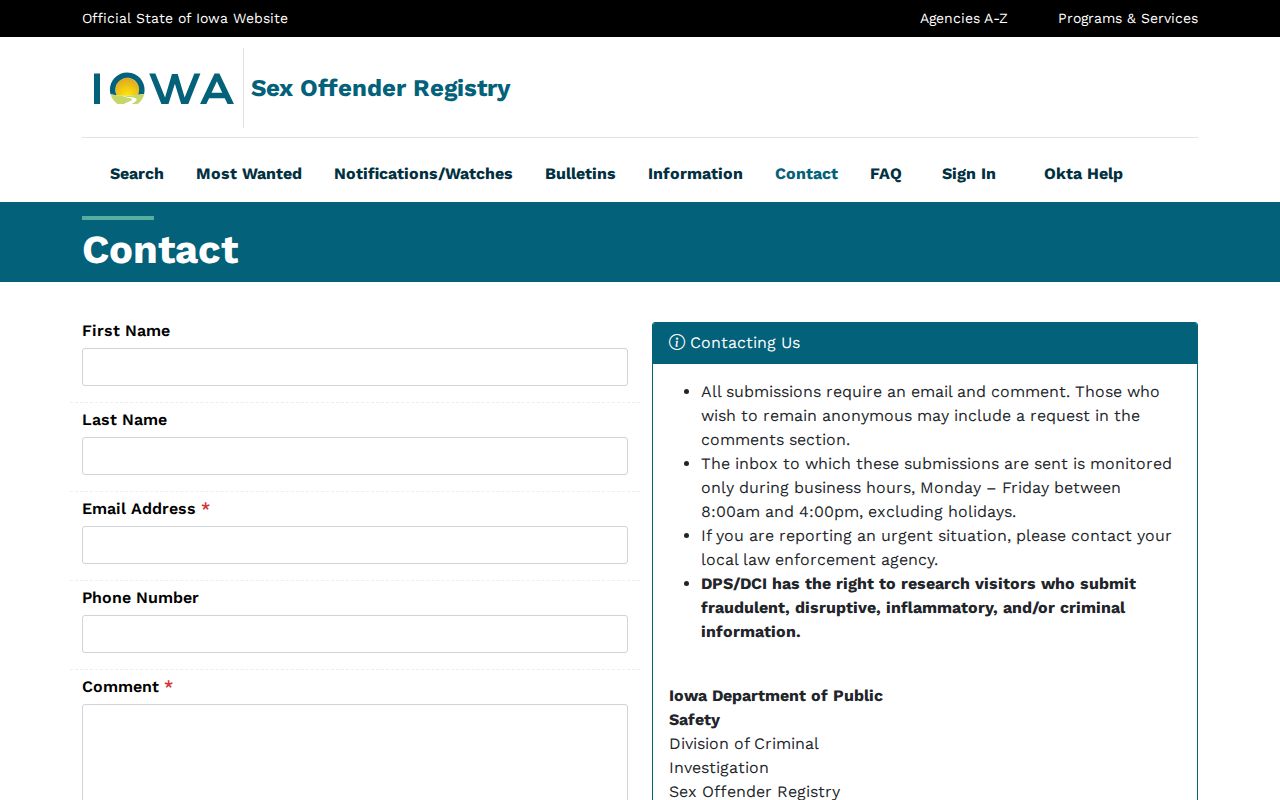
The form is monitored during listed weekday hours; an active crime or immediate threat belongs with local police or the county sheriff.
Iowa Registry Watches Send Alerts
Free email watches use an Iowa Okta account. "My Watches" can follow an address and range, city, county, ZIP, one registrant, or a group. Account settings control the notices. The Iowa portal says an email normally goes out within 60 minutes after registered information changes. Treat that message as a prompt to reopen the official Iowa profile, not as a permanent copy or guarantee of current map accuracy.
Iowa does not require door-to-door notice to every neighbor. Iowa sheriffs provide information to school offices when statutory conditions apply, and agencies may notify child-focused groups or the public through authorized print, meetings, news, radio, and web methods. Iowa local notice and statewide watches serve different purposes. An alert reports a change; it does not authorize confrontation or independent enforcement.
Lawful Use of Registry Data
Iowa registry data exists for public awareness and safety. It does not permit threats, vandalism, assault, stalking, or harassment. Chapter 692A does not create a generic offense named "misuse of search," but ordinary criminal laws apply. Iowa Code section 708.7 covers specified illegitimate threatening or alarming contact, and other conduct can fall under assault, stalking, criminal-mischief, or threat statutes. Never visit an address to confront someone or try to detain a person marked wanted.
Misuse can be a crime. Do not harass, threaten, intimidate, vandalize, assault, or retaliate against a registrant, family member, or associated person.
Report an urgent or ongoing crime to Iowa law enforcement. Tips about a noncompliant profile can go to the Iowa sheriff or DCI. For a cross-state search, the U.S. Department of Justice's National Sex Offender Public Website can query public jurisdictional registries, but the Iowa source remains the better place to verify Iowa detail. The Iowa DCI criminal history agency handles a different type of official record and should not be confused with the Iowa registry.
Note: A registry profile states a legal registration duty; it is not a complete court file or a prediction of future conduct.