
What the Iowa DCI Is
The Iowa Department of Public Safety houses the Division of Criminal Investigation. Within Iowa DCI, the Support Operations Bureau's Records and Identification Unit serves as Iowa's central criminal-history repository. The Iowa bureau also includes criminal-history dissemination, biometric identification work, and the Iowa Sex Offender Registry. Its job is broader than selling an Iowa record check. It identifies fingerprint submissions, maintains linked histories, shares authorized information, and helps contributors improve Iowa record quality.
Scale shows the repository's statewide role. The DPS FY2025 report lists 869,070 automated criminal records, 125,484 biometric submissions processed, and 14,715 new criminal records. It also reports 270,446 state checks and 47,906 national checks. Those totals are agency operations, not counts of convictions.
The official DPS contact directory identifies the Iowa DCI record-check unit and statewide contacts.
The contact listing directs record questions to the state unit without treating one county office as the statewide repository.
Inside Iowa DCI Records
Every Iowa criminal-history record begins with a fingerprint card, according to Iowa DCI. That makes fingerprints the Iowa repository's identity anchor. A public request, however, normally searches by exact name and date of birth. It is not a fresh fingerprint comparison. That distinction matters when Iowa names are common, aliases differ, or identifying data were entered incorrectly.
The DCI Support Operations Bureau describes the Records and Identification function and its central-repository role.
The bureau view connects record dissemination to fingerprint operations, quality review, and statewide identification work.
DCI reported 82 Live Scan and 29 Card Scan devices for electronic submission as of December 2023. Its Multi Biometric Identification System can hold fingerprints, palm prints, mugshots, tattoo photographs, and unsolved latent prints. Those identification holdings are not all public report fields. Chapter 692 controls what the dissemination unit may release, while the underlying biometric system supports authorized state and federal identification work.
Iowa DCI Criminal History Check Options
Iowa DCI offers several routes with different legal scope. Any requester may seek the publicly releasable Iowa name-based product for a named person. A signed DCI-77 release permits DCI to include certain older no-disposition arrests and successfully discharged deferred judgments that an ordinary release suppresses. The subject can also inspect a personal record and use the formal challenge process. Authorized fingerprint checks under chapter 692C are confidential, program-specific services, not public searches.
| Product | Who May Order | What It Returns | Cost |
|---|---|---|---|
| Standard Iowa DCI name check | Any requester naming a specific subject | Publicly releasable Iowa fingerprint-supported history for exact name and birth date | $15 per last name |
| Signed-release DCI check | Requester with the subject's DCI-77 | Standard result plus qualifying restricted categories authorized by the release | $15 per last name |
| In-person self check | The subject with government photo ID | The subject's Iowa DCI report, available immediately during walk-in service | $15 per last name |
| Formal record challenge | The subject or attorney | Agency review and a written decision or order | No published fee |
| Chapter 692C national check | Qualified entities under the statute | Confidential authorized state and FBI fingerprint result | Program cost |
A DCI check covers Iowa. It excludes other-state records, FBI data, and federal-court convictions. A subject seeking a national personal history uses the FBI Identity History Summary process instead.
Iowa DCI Release Rules
A signed release is not required merely to order another person's public Iowa product. It changes what DCI may return. Without the official release, DCI generally omits arrests more than 18 months old when no final disposition is reported. It also suppresses successfully completed and discharged deferred judgments. A DCI-77 can authorize those categories, but it does not make confidential juvenile information public.
The Iowa result is a released product, not direct public browsing of the CCH database. An Iowa “no record” response can reflect restrictions, missing fingerprints, a name mismatch, another-state history, or federal activity. It should not be translated into a claim that the person was never arrested.
How Records Reach Iowa DCI
For a serious or aggravated misdemeanor or felony, the arresting agency generally takes fingerprints and sends them to DPS within two working days under Iowa law. DCI's biometric system identifies the submission and creates or updates an arrest cycle. The arresting agency then routes final-disposition reporting to the county attorney or clerk. The prosecutor, juvenile officer, or clerk reports the filed charge and outcome. Final disposition is due to DPS within 30 days under section 692.15.
Data flow: County Arrest › Fingerprint Submission › Iowa DCI › Court Disposition Reporting › Rap Sheet
Not every Iowa event fits that clean path. Most ordinary simple misdemeanors are not mandatory fingerprint events. A delayed disposition, incorrect identifier, or name-only event can also create an Iowa gap. Three Iowa criminal-history auditors provide training and quality review to law enforcement, county attorneys, and clerks. A federal 2020 benchmark found final dispositions for 98 percent of Iowa arrests overall and 99 percent of felony charges, while the preceding five-year arrest measure was 84 percent.
Iowa DCI Repository Milestones
Iowa's state investigative agency began in 1921 as the Bureau of Criminal Investigation. It became part of the new Department of Public Safety in 1939 and took the DCI name in 1983. Criminal-history Dissemination began in 1996. Live Scan started electronic local fingerprint transmission in fiscal year 1999. These changes moved a card-based identification system toward faster statewide exchange.
A new Iowa CCH database launched on September 9, 2024. It added stronger access controls, dashboards, queues, tracking, and internal notices. At launch, Iowa DCI described about 869,070 active histories and nearly 3.6 million arrest and custody fingerprint submissions. The former public real-time Iowa website is now offline while DPS develops a replacement. The current online route is a staff-processed request and billing form, not an instant database.
Ordering a Check From Iowa DCI
Iowa DCI accepts requests through its current web form and by mail, fax, email, or walk-in service. Telephone requests are not accepted. The minimum subject identifiers are first name, last name, and exact date of birth. The web form also requires gender; middle name and Social Security number can help narrow a possible match. Each current or former surname needs its own request and $15 payment.
- Choose a standard public check, signed-release check, or review of your own Iowa DCI record.
- Gather the exact first and last name, date of birth, helpful identifiers, and DCI-77 when broader authorized release is intended.
- Submit the Iowa DCI request and billing form, or use the official mail, fax, email, or walk-in channel.
- Pay $15 for each last name and choose mail, U.S. fax, or encrypted email delivery.
- Read every arrest and disposition line, then obtain the county court order when source detail or certification matters.
Iowa DCI says requests commonly take one to three days depending on staffing and volume; broader official Iowa guidance says about two to five business days. Only the subject with government photo identification can receive an immediate walk-in result.
The official DCI web request form collects requester, payment, delivery, subject, and optional release information.
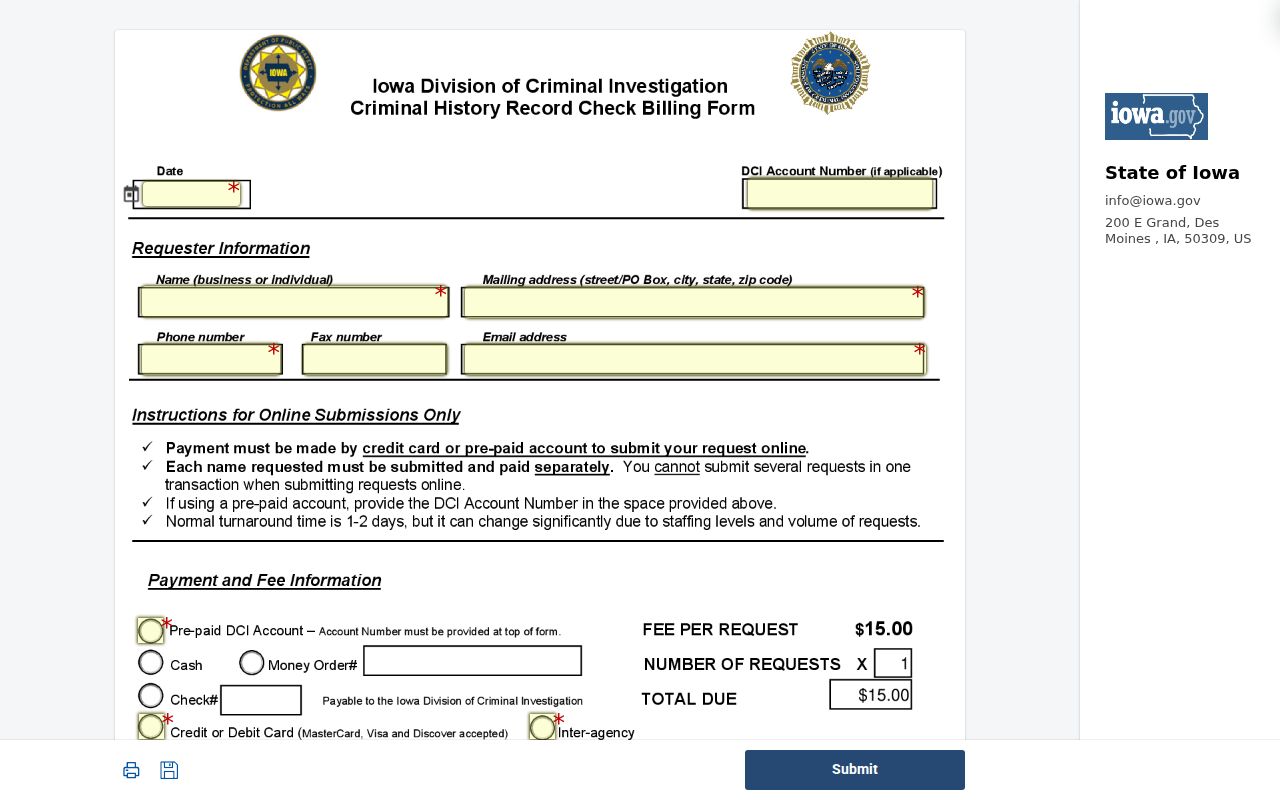
The form confirms that current online access is an intake workflow rather than a live name-search results screen.
Iowa DCI Portal Transition
The legacy Iowa Criminal History Check site is offline for replacement work. DPS gives no firm restoration date. Requests continue through the SeamlessDocs form and the alternate DCI channels, so the outage does not end public access. It changes the process from real-time self-service to staff processing.
The official Iowa criminal-history portal status page carries the current transition notice.
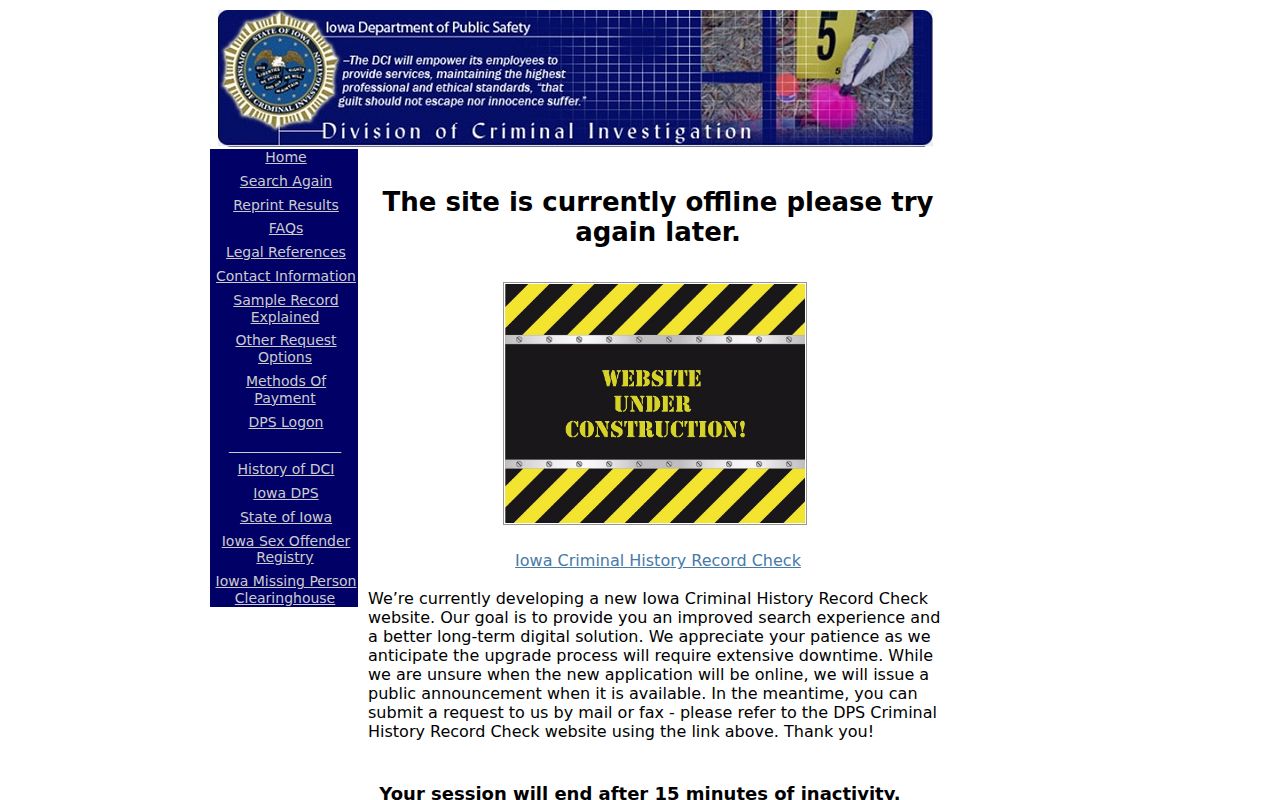
The status notice should be checked before relying on old directions for the former public interface.
County Records vs Iowa DCI Checks
An Iowa DCI check is best for a single statewide repository summary. County records are best for the source file. A clerk's docket shows amended charges, hearings, orders, and financial entries. The arresting agency keeps the event narrative, and a county jail keeps booking and release data. Neither source replaces the other.
| Iowa DCI Check | County Records | |
|---|---|---|
| Coverage | Reported Iowa history from all 99 counties | One county's cases, arrests, or bookings |
| Source | Fingerprint-supported person-centered repository | Original court, police, sheriff, and jail records |
| Freshness | Depends on fingerprint and disposition reporting | Updates as the local event or case moves |
| Detail | Summary arrest cycles and reported outcomes | Documents, docket events, narratives, and booking fields |
| Best use | Reviewing statewide Iowa history | Confirming the exact event, order, or current custody fact |
Use the Iowa county directory to find the clerk, sheriff, jail, or local agency that holds the original. A court docket can exist even when chapter 692 prevents DCI from releasing the same item in a public rap sheet.
What Iowa DCI Cannot Return
Iowa DCI does not provide a national record in its ordinary public product. It excludes other states, FBI information, and federal-court convictions. It also does not contain the full police report, every court filing, or a complete county jail history. A missing Iowa entry may result from a nonfingerprinted simple misdemeanor, delayed disposition, identifier mismatch, lawful restriction, or an event outside Iowa.
For a personal national fingerprint history, the subject may use the FBI electronic Identity History Summary. For filed Iowa cases, use Iowa Courts Online and the county clerk. Federal criminal dockets use PACER, while local arrest reports remain with their creating agencies. These are separate official systems with different purposes.
Fixing Errors in an Iowa DCI Record
Iowa Code section 692.5 lets a person or attorney inspect and copy that person's Iowa record. DCI may request fingerprints to confirm identity. Prints supplied only for that review must be returned or destroyed without copying. A challenge can address inaccurate, nonfactual, unauthorized, or otherwise improper information. DCI must issue a written decision or order within 20 days after a formal challenge.
- Order or inspect your own Iowa DCI history and identify the exact arrest cycle, charge, or disposition in dispute.
- Get the source police record or certified county court order that proves the correct fact.
- Submit a written challenge to Iowa DCI with the disputed field and supporting record clearly identified.
- Review the written decision, request a fresh copy after correction, and use chapter 17A judicial review if needed.
When corrected Iowa data had been sent to the FBI, Iowa DCI must notify the FBI. The subject may also elect to close a challenge. Iowa expungement is different: the qualifying county court enters the order, then sends notice for removal of covered conviction information from DPS files.
Iowa DCI Law and Contact
Iowa DCI record checks are handled through the Oran Pape State Office Building, 215 East 7th Street, Des Moines, Iowa 50319. The record-check desk is 515-725-6066, dcirecordchecks@dps.state.ia.us, and fax 515-725-6080. Public DCI business hours are 8:00 a.m. to 4:30 p.m. weekdays, with walk-in checks listed from 8:00 a.m. to 4:00 p.m. Recheck the official contact page before travel.
The official Iowa criminal-history law supplies the current chapter 692 provisions.
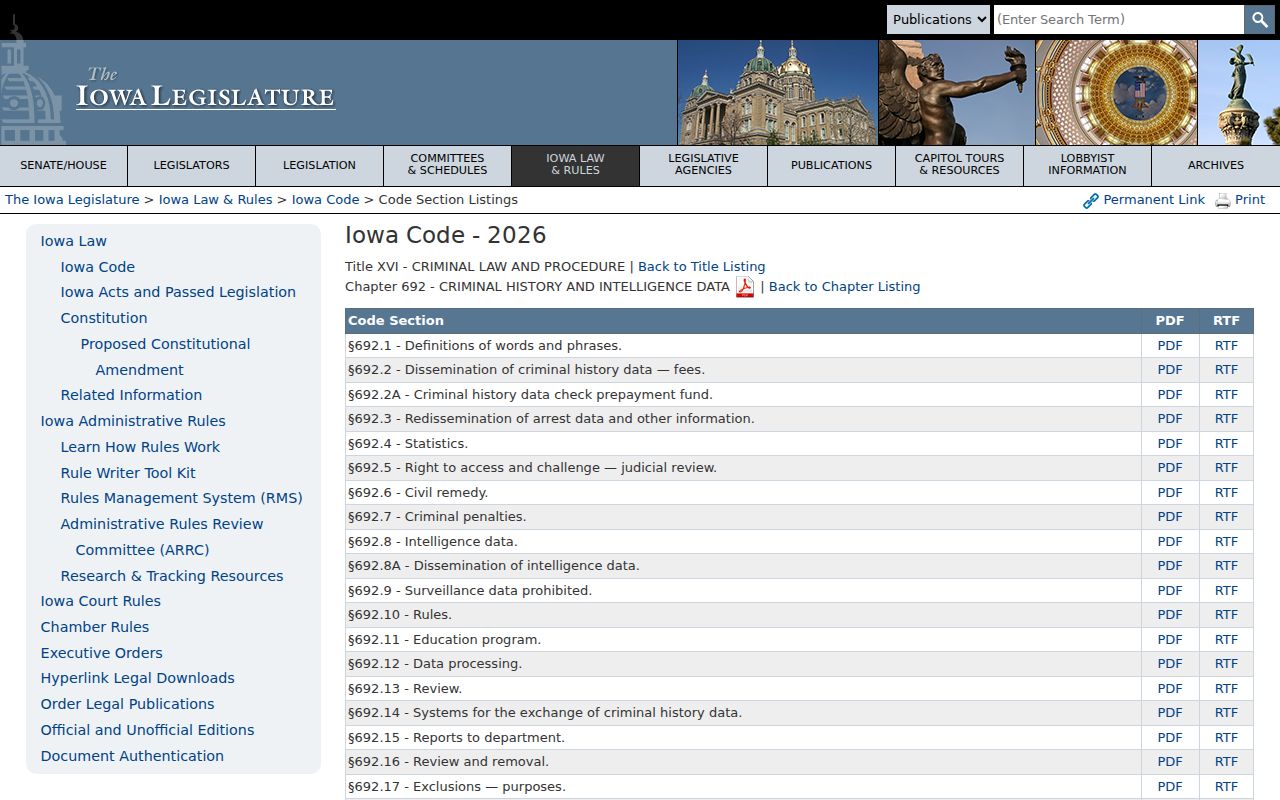
The statute sets the boundary between the statewide repository product, subject-review rights, and independently public county records.