
Criminal Court Cases in Iowa
Iowa has one unified trial court, the Iowa District Court. It operates through all 99 counties. Iowa district judges have broad authority, including Class A through C felonies. Iowa district associate judges may hear Class D felonies and indictable misdemeanors. Iowa magistrates handle simple misdemeanors, complaints, preliminary hearings, warrants, and bail. These are judicial levels within one Iowa court system, not unrelated local courts.
An Iowa clerk of district court keeps the official file in the county where the charge was filed. Iowa Courts Online gathers docket data from those clerk offices into one statewide index. An Iowa appeal is first filed with the Iowa Supreme Court. That court may keep the matter or transfer it to the Court of Appeals. The Iowa court hierarchy is statewide, while custody of the trial file stays local.
The Judicial Branch's District Court overview shows how that unified structure works.
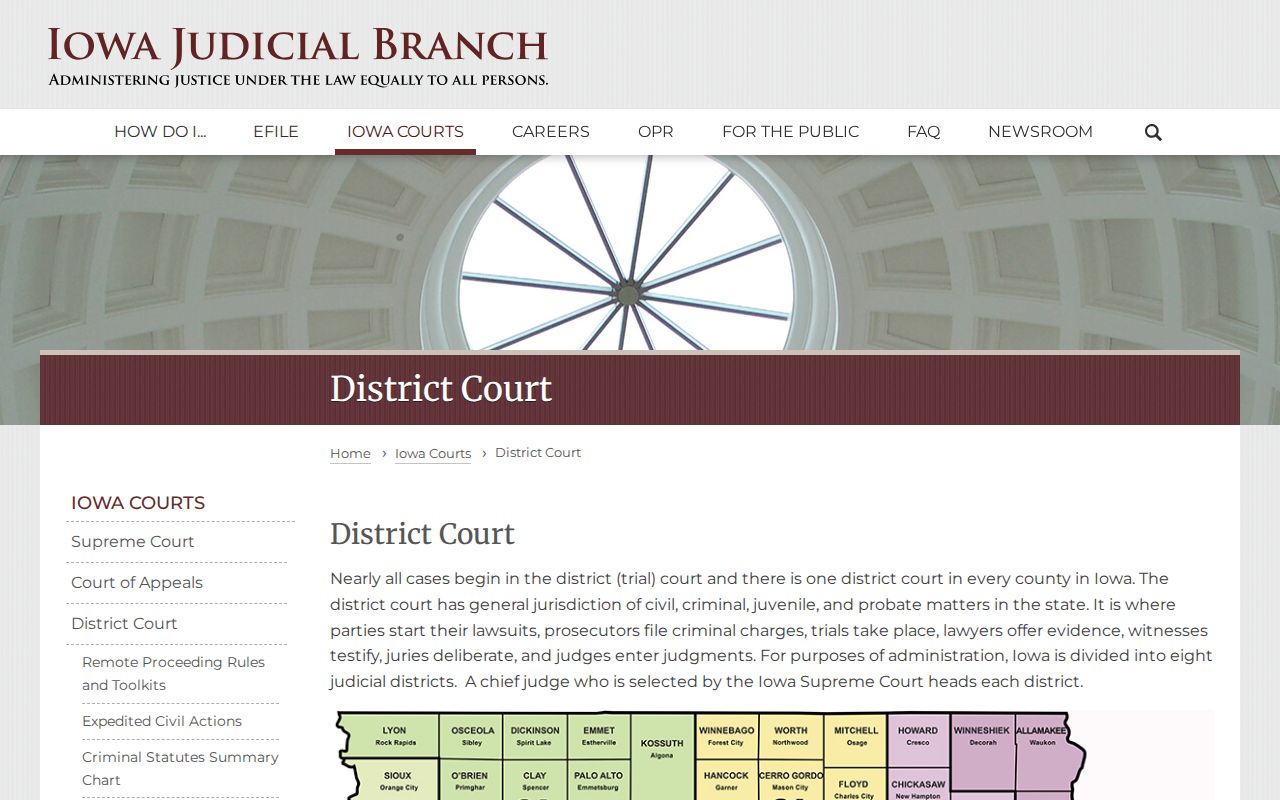
This statewide structure explains why one search can find Iowa cases while a county clerk still supplies the official record.
Iowa Criminal Case Labels
Iowa case IDs and docket labels help separate types of Iowa court records. FE marks a felony case. AG marks an aggravated misdemeanor, while SR and SM identify serious and simple misdemeanors. OW is used for operating-while-intoxicated matters. CR is a general criminal label, and PC identifies postconviction relief. An Iowa prefix helps classify the file, but it does not state the outcome.
- Trial information
- The prosecutor's common charging document for an indictable Iowa offense. It often replaces a grand-jury indictment.
- Disposition
- The result for one charge, such as dismissal, acquittal, conviction, amendment, or deferred judgment.
- Deferred judgment
- An Iowa outcome that delays entry of judgment and may support expungement after successful discharge.
- SID number
- The state identifier that links fingerprint-based events in the Iowa DCI repository.
Read the charge-level result rather than relying on the file prefix or a broad case status. One Iowa criminal case can contain several counts with different outcomes.
Iowa also uses two paths for a formal indictable charge. A county attorney commonly files a trial information with minutes of testimony. A seven-person grand jury can instead return an indictment when at least five members concur. Both documents accuse; neither proves guilt. The later docket must be read for amendments, pleas, trial results, dismissals, and the final judgment on each count.
Searching Iowa Courts Online
Iowa Courts Online Search provides free public docket access without a subscription. It is an index and summary, not the official Iowa court record. A registered Advanced Case Search costs $25 per month and adds more Iowa search types. Public documents may be viewed at a courthouse terminal in the filing county, while copies and certifications come from that Iowa clerk.
- Open Iowa Courts Online and choose the public case-search panel.
- Enter at least two letters of the last or firm name. Add the first name or initial to narrow the results.
- Select an Iowa county when it is known, or leave the search statewide. A full 17-character case ID can identify one file.
- Open the Iowa result and review parties, charges, events, bonds, financial entries, and each disposition separately.
- Ask the Iowa filing county clerk for a document, courthouse-terminal access, or a certified copy when the index is not enough.
| Field Label | Type | Required | Notes |
|---|---|---|---|
| Last/Firm Name | Text | Yes for name search | At least two letters; the % wildcard is accepted. |
| First Name | Text | No | An initial may be used without a period. |
| Second Name | Text | No | AND or OR connects two people or entities. |
| County | Selector | No | Search statewide or limit the Iowa case results. |
| Case ID | Text / mode | No | The full ID has 17 characters; zero and O differ. |
The official Iowa Courts Online interface shows the search entry point and its statewide scope.
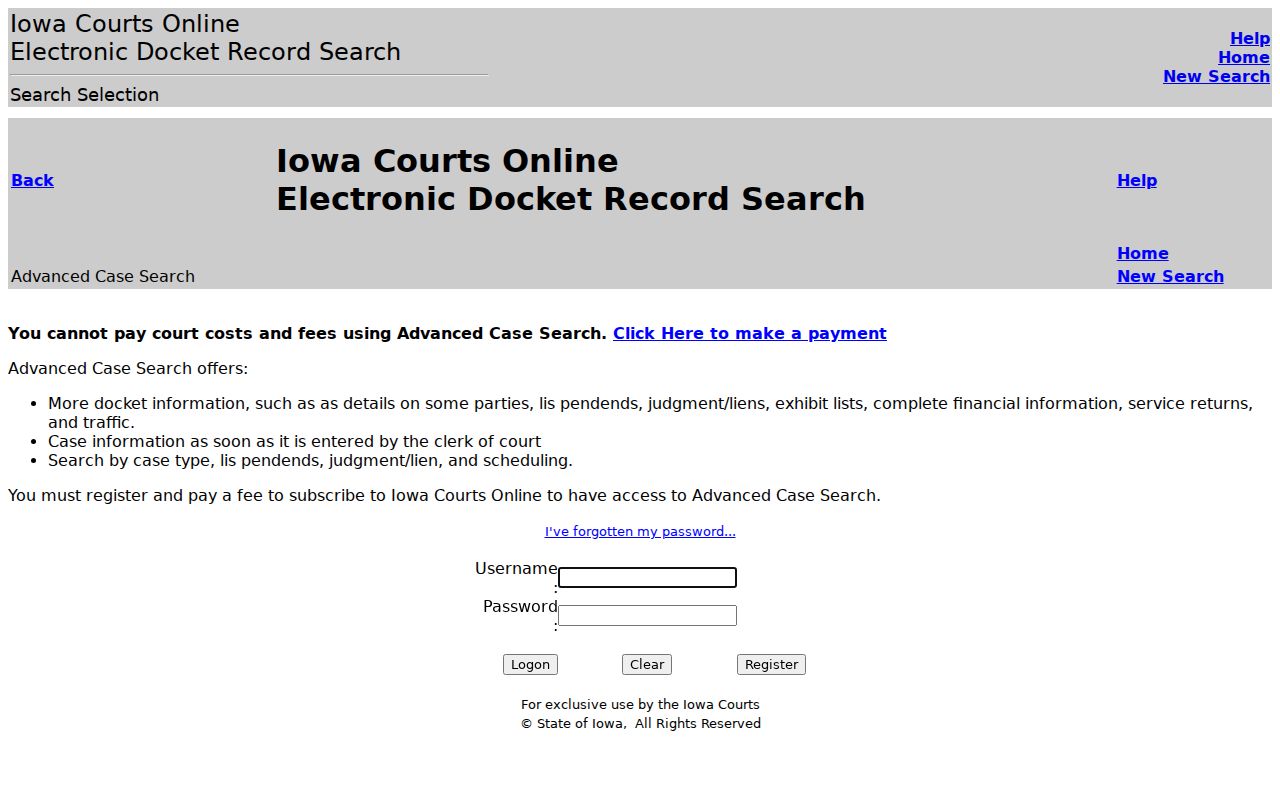
The interface is useful for locating a file, but the clerk remains the source for a conclusive Iowa court document.
Iowa Disposed Is Not Convicted
“Disposed” means a court has resolved an item. It does not always mean guilty. An Iowa count can end through conviction, dismissal, acquittal, amendment, or deferred judgment. A case with several counts may show a mix. The correct approach is to open the charges and dispositions area, pair each count with its result and date, and then read the judgment or dismissal entry.
Iowa financial entries also need context. A listed fine, cost, surcharge, restitution balance, or payment does not by itself describe every count's outcome. Iowa bonds are separate again. A bond amount records pretrial release terms, not guilt. When the online summary leaves doubt, the signed order in the Iowa county file controls.
Inside an Iowa Criminal Case File
An Iowa criminal case file follows one prosecution, not a person's full statewide history. The docket can identify parties, counsel, the prosecuting authority, each charge, bond events, filings, hearing dates, outcomes, sentencing, and financial obligations. Some entries summarize a document that is not remotely viewable.
| Case ID & County | The 17-character identifier, filing court, case type, status, judge, and last activity. |
|---|---|
| Charging Documents | The complaint, trial information or indictment, counts, code citations, and amendments. |
| Docket Events | Filed motions, hearings, pleas, trial activity, orders, warrant actions, and appeals. |
| Bonds | Bond type, amount, posted date, release, forfeiture, and related service information. |
| Disposition | The result and date for each count, which may differ within one case. |
| Sentence & Financials | Confinement, probation, fines, costs, restitution, payments, and balances. |
The Iowa DCI rap sheet is different. It organizes fingerprint-supported arrest cycles around a person and adds reported outcomes. It does not replace the original Iowa court file, police narrative, or signed judgment.
Missing Iowa Court Documents
Free remote access does not include every filing as an image. Start with the docket description, date, and filing party. Then contact the clerk in the filing county and name the exact document. Public documents can be inspected on a courthouse terminal. Older Iowa files may require paper, microfiche, or archive retrieval. The Judicial Branch guide lists a representative copy charge of 50 cents per page, with possible added supervision or special-service costs, so confirm the current total with the clerk.
The Judicial Branch Iowa court forms library is the official source for published forms.
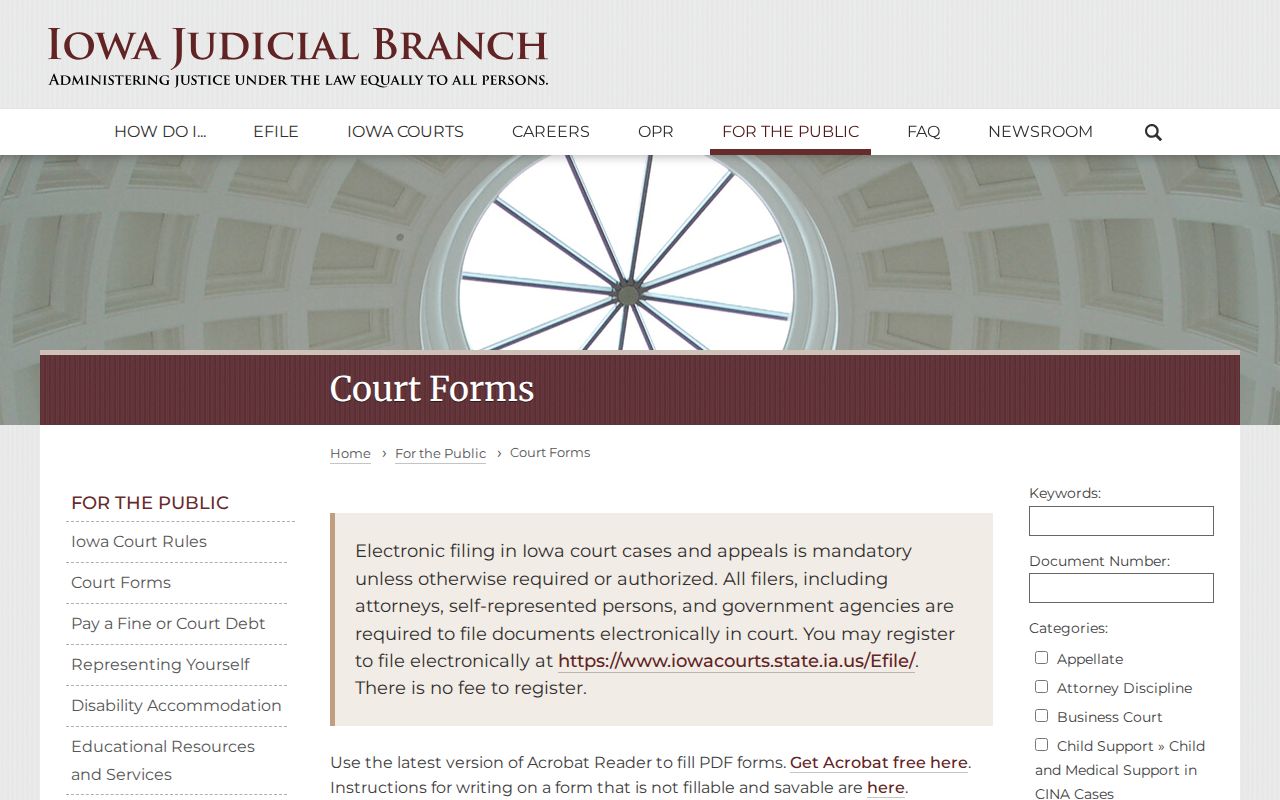
The forms library helps identify current Iowa filings, but it does not supply a completed document from a specific criminal case.
How an Iowa Criminal Case Moves
An Iowa case may begin with arrest or citation and an initial appearance. For a person held after arrest, that appearance generally occurs within 24 hours. A magistrate addresses the charge, counsel, and release. A preliminary hearing may follow, though it can be waived or displaced by formal charging. For an indictable offense, the county attorney commonly files a trial information with minutes of testimony. A seven-person grand jury may instead indict when at least five members agree.
Arraignment records the plea. Discovery, depositions, and motions create later docket entries. A plea or trial then leads to a result for each count. If convicted, the judgment may impose jail or prison, probation, fines, costs, restitution, or other conditions. An appeal is filed with the Iowa Supreme Court, which may retain it or transfer it.
Case flow: Charges Filed › Arraignment › Pretrial › Plea or Trial › Disposition › Sentencing
Restricted Iowa Criminal Court Records
Public access has firm limits. The Judicial Branch restricted-document schedule excludes unserved arrest and search warrant material from ordinary viewing. Juvenile matters, presentence reports, protected identifiers, and sealed or expunged cases also have special rules. An absent Iowa docket may reflect lawful restriction, a recent filing delay, an indexing variation, or an older archived file. It should not be treated as proof that no event exists.
Iowa Code chapter 22 governs many government records, while court access also follows Judicial Branch rules. Chapter 901C can make a qualifying case confidential after an expungement order. That court result must also be reported so qualifying information can be removed from the DPS criminal-history file.
Note: A citation can take up to 14 days to appear in Iowa Courts Online, and city parking violations are outside this system.
Iowa Court Files Versus Rap Sheets
A court file and an Iowa DCI criminal history answer different questions. The court file shows what prosecutors filed, how counts changed, which hearings occurred, and what the judge ordered. The DCI record is a person-centered statewide summary built from fingerprint-supported arrest data and reported dispositions. Its ordinary public release is controlled by chapter 692.
| Record | Best Evidence | Common Omission |
|---|---|---|
| Iowa court file | Filed charges, orders, disposition, and sentence | Uncharged arrests and police narratives |
| Iowa DCI history | Fingerprint-linked Iowa arrest cycles and reported outcomes | Full documents, other states, FBI data, and federal convictions |
| County booking record | Custody intake, booked charge, bond, and release | Later prosecutor choices and final judgment |
A missing final outcome on an Iowa DCI report should be checked against the county's certified order. The record subject can then use the Iowa DCI challenge process if the repository entry is inaccurate or incomplete.
Case Records at the County Level
The clerk of district court in the filing county holds the official Iowa criminal case file. That local source is essential for certified judgments, complete filings, older material, and documents named but not displayed online. Arrest reports remain with the police or sheriff that created them. Recent booking details remain with the county jail. Geography determines the custodian even though the court system is unified.
Use the directory of all 99 Iowa counties to reach the right local criminal-record source. Start with the case county shown in Iowa Courts Online. Give the clerk the case ID and exact document name, then ask about inspection, certification, archive retrieval, and current copy charges.