
Iowa Arrest History
An Iowa arrest record begins with the peace officer and agency that took action. The creator may be a city police department, county sheriff, the Iowa State Patrol, Iowa DCI, campus police, or another authorized agency. That office keeps the incident and arrest report. If the person enters a county jail, the sheriff records intake data, identifiers, the alleged charges, bond, custody location, release information, and a photograph when one is taken. Those Iowa arrest records remain distinct even when they describe the same event.
Fingerprinting connects many serious and aggravated misdemeanor or felony arrests to the Iowa DCI repository. Iowa Code section 690.2 generally requires covered prints to reach the Department of Public Safety within two working days. Iowa courts and prosecutors then supply later charging and disposition information. A citation, an event outside the fingerprint rule, a delayed report, or a failed identity link can leave a gap. That is why neither an Iowa county booking result nor a DCI response should be read as the whole Iowa arrest history.
Note: Iowa arrest records document an accusation and custody event; they do not establish guilt or show the final court result.
Iowa Arrest Counts Need Context
The Crime in Iowa dashboard is DCI's statewide source for aggregate incident, offense, victim, offender, property, and arrestee statistics. Its report center can filter by year, county, agency, municipality, demographic group, and arrest category. This is a statistics system, not an Iowa arrest lookup by name. It can show how often agencies reported an event, but it cannot supply a person's report, booking sheet, or case outcome.
The latest fully comparable FBI calendar-year 2024 figures in the research count 78,514 reported Iowa arrest events. They include 10,365 drug or narcotic arrests, 10,291 simple-assault arrests, 9,216 DUI arrests, 8,310 larceny arrests, and 3,782 aggravated-assault arrests. The unit is an arrest event, not a unique person and not a conviction. Iowa also warns that its figures are dynamic, that migrated 2016 through 2020 data call for care, and that data from 2021 forward publish after certification.
The official Crime in Iowa source shows the interface used to set that statewide context.
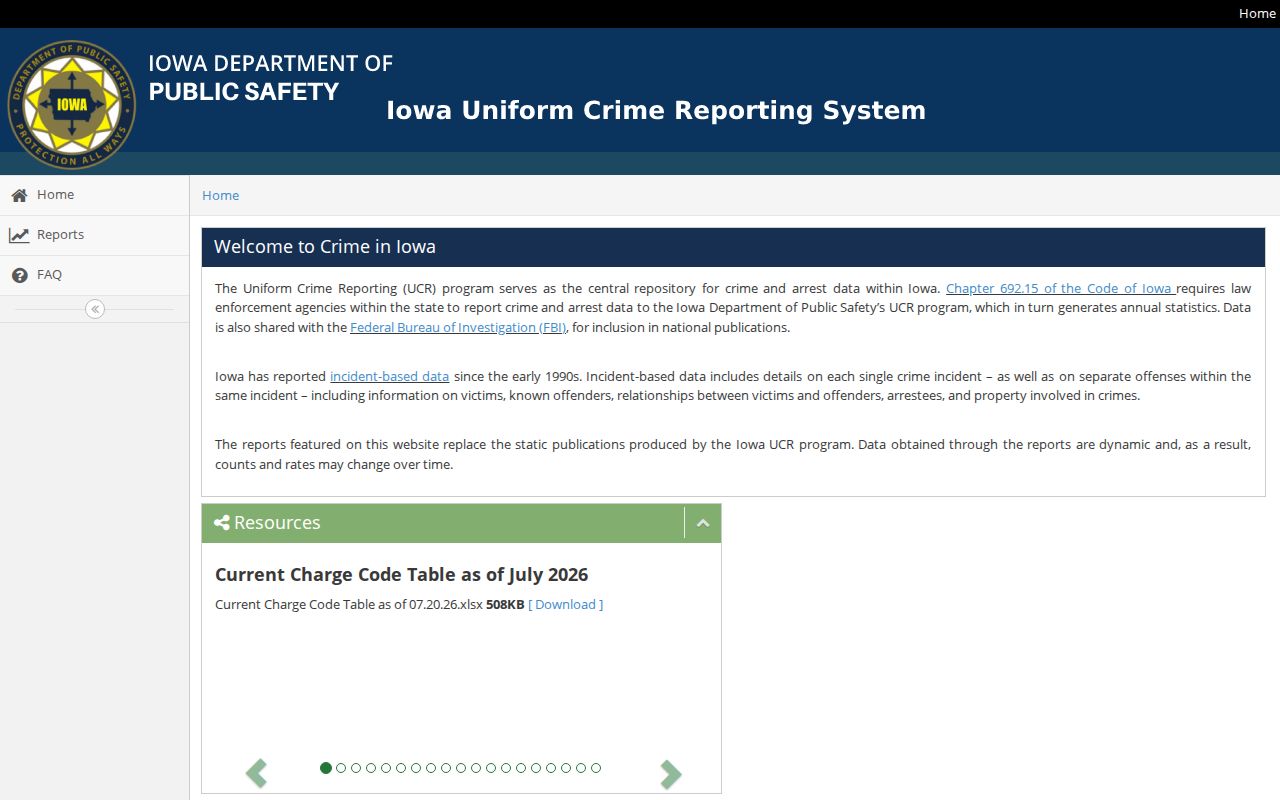
The dashboard's filters separate trend research from the person-level Iowa arrest records held by agencies, jails, courts, and DCI.
How Iowa Arrests Reach the Record
Iowa's statewide cycle starts locally. An officer makes an arrest or issues a qualifying citation. The Iowa agency records the immediate facts. A jail booking adds custody details, while a fingerprint card or LiveScan submission anchors identity. Iowa DCI receives the fingerprint-supported arrest cycle and tracking data. Under Iowa Code section 692.15, the arresting agency starts a disposition form, and the county attorney or clerk later reports charging and final disposition information, generally within 30 days of the result.
Data flow: Arrest › Booking › Fingerprints › Iowa DCI › Court Disposition
Timing affects every Iowa arrest lookup. An Iowa local booking can appear within hours. An initial court appearance often follows within ordinary custody time, yet a citation may take up to 14 days to enter Iowa Courts Online. The prosecutor can decline, replace, or amend the booking allegations. A final outcome can take much longer, then still needs to flow back to Iowa's repository. When two sources disagree, compare identifiers, dates, case numbers, and the newest official entry rather than assuming one system is universal.
Who Holds Iowa Arrest Reports
An Iowa sheriff holds its own arrest reports and county jail data. An Iowa city police records custodian handles that department's events. The Iowa State Patrol and DCI use Department of Public Safety records channels. Iowa campus public-safety offices retain records they create. No one office replaces these custodians, even though DCI compiles fingerprint-linked Iowa arrest history information.
| Source | Best Record | Main Limit |
|---|---|---|
| Arresting agency | Incident and arrest report | Active investigative, victim, juvenile, safety, or work-product details may be withheld |
| County jail | Recent booking, bond, custody, and release | County window and fields vary |
| Iowa DCI | Disseminable fingerprint-linked Iowa history | No local narrative, federal cases, or other-state history |
| Iowa Courts Online | Filed charges and outcomes | Not the arrest report or every document image |
A representative official county roster illustrates why local searches can use fields and time windows that differ from statewide records.
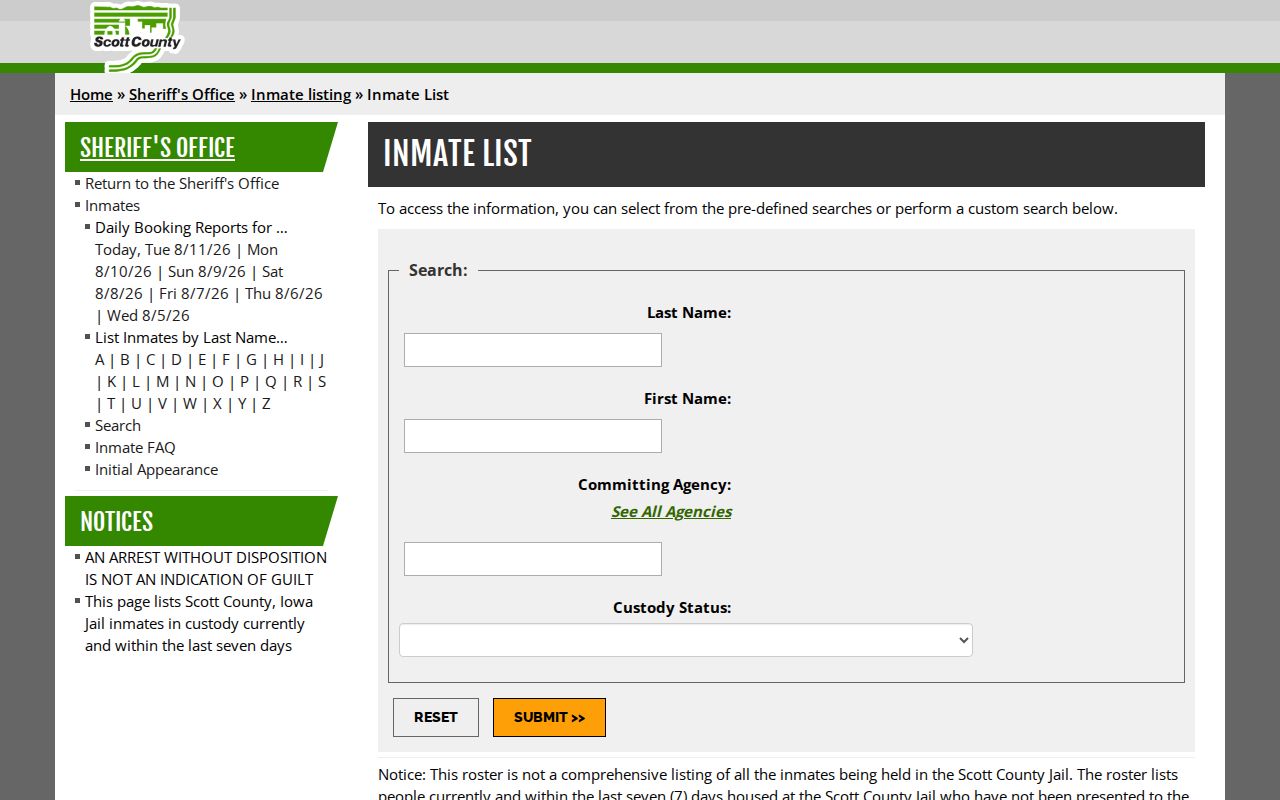
The roster view reinforces a key limit: a local custody result is useful for recent Iowa booking facts, not for a statewide history or a finding of guilt.
Looking Up Arrests in Iowa
A sound Iowa arrest lookup starts with the reader's goal. Use an Iowa jail or arresting agency for a recent event, DCI for disseminable statewide history, and Iowa's court system for the filed case and outcome. Iowa has no one public name search that combines all Iowa local incident reports and jail rosters. Iowa's current route therefore begins where the arrest occurred and expands only as needed.
- Identify the Iowa county and agency. Search the Iowa sheriff's current, recent, or release roster when available, then ask the agency that made the arrest for its report.
- Use the county route. Open the directory of all 99 Iowa counties to find the local jail, sheriff, police, and clerk channels tied to that event.
- Check statewide history. Use the official Iowa DCI Criminal History Record Check request with the subject's first name, last name, and exact date of birth. It costs $15 per last name.
- Confirm the court result. Search Iowa Courts Online and obtain key filings or certified records from the filing county's clerk of district court. A docket, not a booking line, shows how the case moved.
DCI's former real-time site is offline while DPS develops a replacement. Its current web billing and request form remains available, along with mail, fax, email, and walk-in methods. DCI states a normal response may take one to three days depending on workload, while other official guidance gives roughly two to five business days. Telephone requests are not accepted.
Iowa Mugshots Are Not Verdicts
Iowa Code chapter 22 does not create a verified blanket exemption for every booking photograph. Section 22.7 treats current and prior arrest records as public in relevant part, but agencies may still withhold or redact material tied to an active investigation, safety, juveniles, victims, medical information, or another legal restriction. Counties also choose different roster fields and lookback periods. An image visible in one Iowa arrest lookup may be absent from another for a lawful or practical reason.
Access never changes what the photograph means. A mugshot shows that a booking image was taken. It does not prove the allegation, a filed charge, or a conviction. The best check pairs the booking entry with Iowa Courts Online and the Iowa county clerk's source file. No private person's photo should be republished or used to invite threats or a claim that the person was found guilty.
Public does not mean complete. Request an existing record from its official custodian, expect lawful redactions, and verify the court disposition before drawing a conclusion.
Inside an Iowa Arrest Record
Iowa arrest records can combine identity, event, custody, and court-link fields, but no single source displays them all. An Iowa police report may contain immediate facts and narrative. Iowa's booking system emphasizes intake and detention. DCI emphasizes fingerprint identity and reported cycles. Iowa courts supply the later legal path. Blank or missing data may reflect the custodian's role, a reporting delay, a restriction, or a field that source never collects.
| Name and Identifiers | Legal name, aliases, date of birth or age, sex, race, and fingerprint-linked identifiers when authorized for release. |
|---|---|
| Arrest Event | Date, time, place, arresting agency, officer, and incident or arrest number. |
| Booking Details | Booking number and time, receiving jail, photograph if taken, and custody or release status. |
| Allegations | Booking charge, cited Iowa Code or local provision, offense class, and later amended counts when reported. |
| Bond and Court Link | Bond amount or type, initial appearance, court case number, and related warrant or detainer information. |
| Reported Disposition | Dismissal, plea, verdict, sentence, or another outcome after the prosecutor or clerk returns it to DCI. |
Note: Narrative, victim, witness, medical, juvenile, and active-investigation material may be redacted even when basic Iowa arrest facts are public.
Iowa VINE Tracks Custody Changes
Iowa VINE searches participating jail and Iowa DOC custody or supervision data and offers free change notifications. A user can search by name or offender ID, then register online or by phone for notice of apprehension, transfer, release, escape, death, and other listed changes. The service helps follow custody after an Iowa arrest, but it is not a rap sheet, court docket, or complete list of every agency event.
The official Iowa VINE source shows the custody-search and notification starting point.

Use that notification channel with the Iowa county roster and court docket, since a transfer can change identifiers and require a new registration.
VINE enrollment is also different from formal victim registration with Iowa DOC or the Board of Parole. Formal registration begins through the prosecuting county attorney. If a roster is empty, check whether the person was released, transferred to Iowa DOC, moved to federal custody, or entered under another identifier. Then verify the case in Iowa Courts Online and contact the correct records custodian.
When Iowa Arrest Data Changes
An Iowa arrest entry can change visibility without vanishing from every source. Under chapter 692, arrest data lacking a disposition becomes restricted from ordinary public DCI dissemination after 18 months, subject to access for justice agencies, the subject or attorney, and a person with a signed release. The released history must warn that an arrest without disposition is not an indication of guilt. At four years without disposition, section 692.16's review and removal rule applies to specified adult computerized arrest or custody information unless a warrant or detainer exists.
Expungement is a separate court process. Iowa Code chapter 901C allows qualifying dismissed or acquitted cases to be expunged after statutory conditions are met, including the waiting rule and payment of court debt where applicable. Other narrow paths apply to certain misdemeanor convictions or deferred judgments. Relief in the court record and removal from DPS files depend on the particular statute and clerk notice. The underlying agency record may follow its own lawful retention rules.
This timeline is why old Iowa arrest history should be checked at both the Iowa repository and county court. A missing DCI item might be restricted, expunged, misidentified, never fingerprinted, or never reported. A visible local log may have a different retention window. For a suspected error in one's own record, obtain the DCI response and source case, then use the chapter 692 subject-review and challenge process.
Arrests vs Convictions in Iowa
An Iowa arrest is an accusation event created by an officer and often a jail. A conviction is the court's judgment after a guilty plea or verdict. Prosecutors can decline a booked allegation, file a different count, or dismiss a case. Courts may acquit. The distinction matters in any Iowa arrest lookup because repository dissemination, expungement, and public access rules can treat arrests without outcomes differently from convictions.
| Arrest Record | Conviction Record | |
|---|---|---|
| Created by | Arresting agency and county jail | Iowa District Court judgment reported to DCI |
| What it proves | A person was arrested, cited, or booked on an allegation | Guilt was established by plea or verdict on a stated count |
| Best source | Agency report and county booking record | Iowa Courts Online and the clerk's case file |
| Statewide view | DCI when fingerprint-linked and disseminable | DCI when the disposition was correctly reported |
| Relief | Chapter 692 restrictions and qualifying chapter 901C expungement may apply | Only specific statutory expungement or other relief routes apply |
Note: An Iowa arrest entry with no disposition is not proof of guilt; confirm the filed case and judgment with the county court.
When the case record is the main question, the Iowa criminal court cases source separates docket events and judgments from the original booking event. The two records answer different questions and should be read together only after identity and case numbers match.