
Checking Criminal History in Iowa
Start by deciding what the record must establish. A state history from the Iowa Department of Public Safety Division of Criminal Investigation, or Iowa DCI, groups Iowa arrest cycles and reported outcomes around a person. Iowa Courts Online groups activity around filed court cases. A local agency holds the event report or booking, and Iowa DOC covers state custody and many supervision statuses. None is a universal substitute for the others.
The official Iowa.gov request overview confirms the state check is Iowa-only. The image below shows the state entry point for that process.
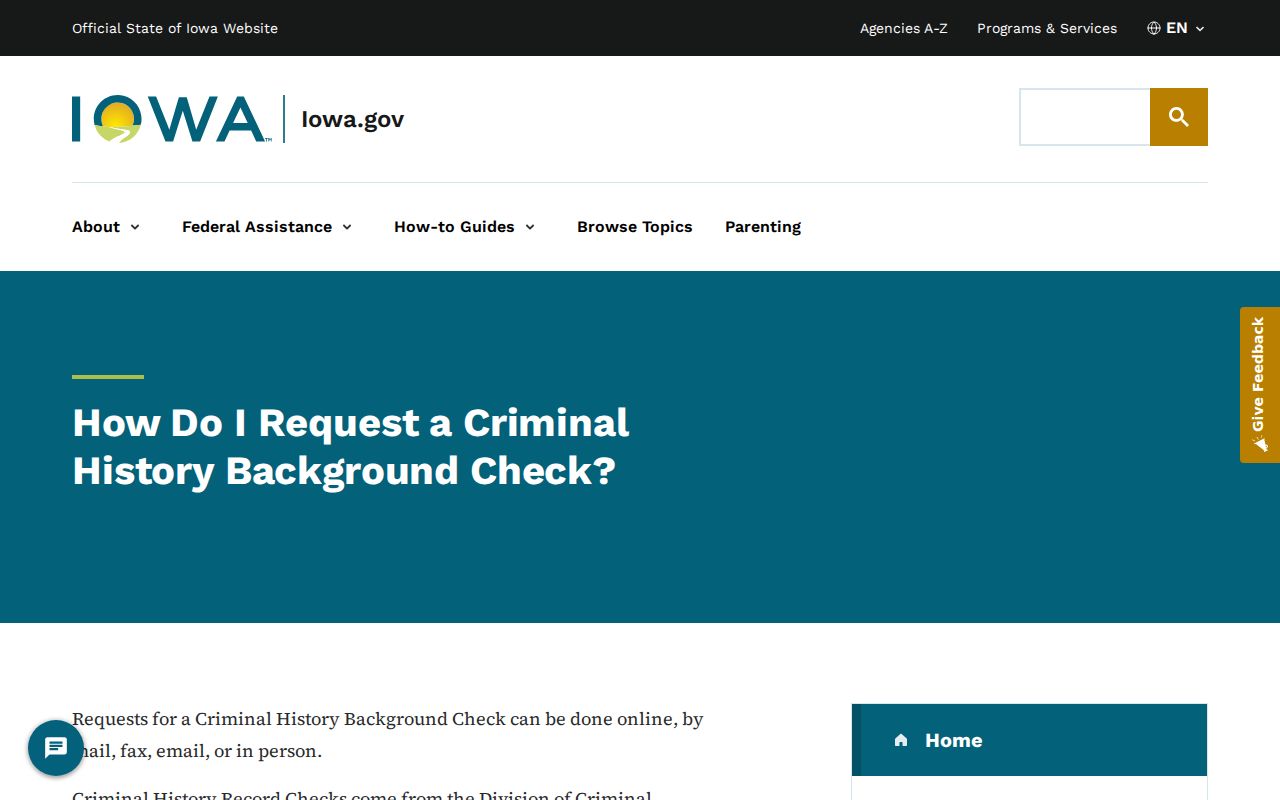
Its limits matter: other states, FBI information, and federal convictions require different channels.
- Choose DCI for a released statewide Iowa history, or Iowa Courts Online for a filed case.
- Gather the exact first and last name and date of birth. Add helpful identifiers when the official form permits them.
- Use the filing county for certified court documents, the arresting agency for the narrative, and the county jail for recent custody.
- Read each charge and disposition separately. A name match, arrest, or closed case is not by itself proof of conviction.
- For your own record, use the official self-review and challenge routes when a source is missing or wrong.
Choosing the Right Iowa Record
Three records can describe one Iowa event without being identical. The arresting agency records what officers alleged and observed. A jail logs intake, booked charges, bond, and release. The Iowa District Court shows what prosecutors filed and how each count ended. Iowa DCI then links fingerprint-supported arrest data to reported dispositions in a person-centered history.
| Record | Best Evidence Of | Common Limit |
|---|---|---|
| DCI history | Iowa arrest cycles and releasable reported outcomes | No local narrative, other-state history, or federal conviction |
| District Court case | Filed counts, docket events, orders, and sentence | No unfiled arrest; restricted material stays hidden |
| Booking record | Local intake, custody, booked charge, and bond | Does not prove the later court outcome |
Record flow: Arrest › Booking › Fingerprint submission › County case › Disposition report › DCI history.
Inside the Iowa Criminal History Repository
Iowa DCI's Records and Identification Unit is the central repository. Every Iowa criminal-history record begins with a fingerprint card, though the ordinary public request uses a name and exact date of birth to search that fingerprint-supported store. Serious and aggravated misdemeanor or felony prints generally move from the arresting agency to DPS. County attorneys and clerks then report charging and final disposition data under chapter 692.
The Iowa DCI record-check page shows the current request choices and their limits.
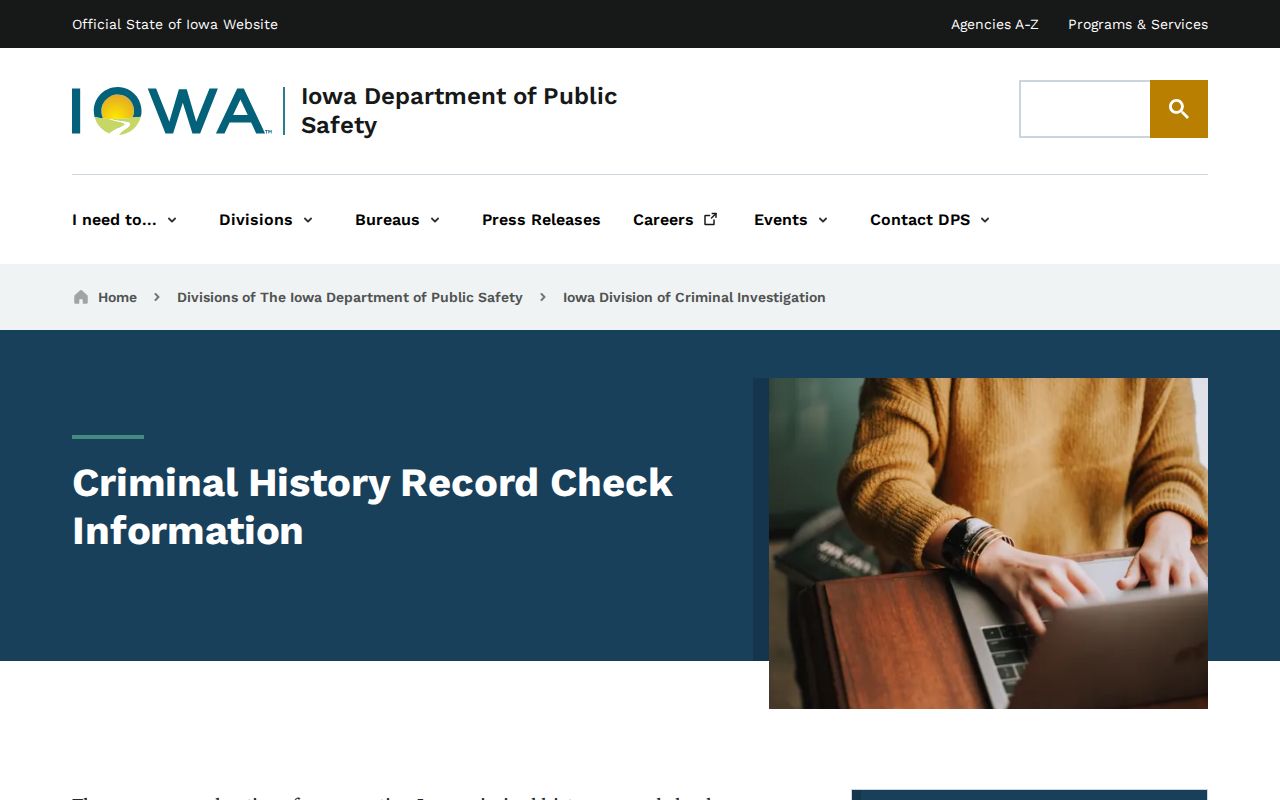
The agency's product is a released report, not open browsing of the full repository. The deeper Iowa DCI criminal records agency profile covers ordering, releases, and corrections.
How Iowa Records Reach DCI
Local reporting shapes state accuracy. For qualifying arrests, fingerprints are due to DPS soon after the event. Final dispositions are due after the county process ends. DCI uses biometric identity and transaction numbers to attach the result to the correct cycle. A delayed report, missing prints, amended charge, or name variation can leave the court docket and DCI response out of step.
If Iowa Courts Online shows a final order that the DCI history lacks, obtain the source order from the filing clerk. Then use the subject review and challenge process under Iowa Code section 692.5. DCI issues a written decision on a formal challenge within the statutory review window and can notify the FBI when transmitted data is corrected.
Key pointer: A county case file and a DCI rap sheet answer different questions. Check both before concluding that either one is complete.
Iowa Statewide Record Systems
Iowa's public systems are linked for operations, but their public pages are not merged. Iowa DOC exchanges data with courts, county attorneys, DCI, VINE, and other partners. That connection does not make an offender profile, registry listing, case docket, or rap sheet interchangeable. Search the source closest to the fact being checked.
| System | What It Holds | Run By |
|---|---|---|
| DCI Criminal History Record Check | Releasable Iowa fingerprint-supported history | Iowa DPS/DCI |
| Iowa DOC Offender Information | State custody and public supervision status | Iowa Department of Corrections |
| Iowa Sex Offender Registry | Public chapter 692A registration information | Iowa DPS/DCI and county sheriffs |
| Iowa Courts Online Search | Statewide District Court docket index | Iowa Judicial Branch |
| Iowa VINE | Participating custody status and notifications | Participating Iowa agencies |
The Iowa Sex Offender Search is a current-duty system, not a full criminal history. Public profiles expose the fields chapter 692A permits, while county sheriffs perform registration and verification. The registry may omit people whose duty ended, people incarcerated in another system, confidential juvenile matters, and information reserved for official use. Searchers should read offense and status fields without assuming that a map point proves current presence at that exact spot.
Arrest information also needs its own route. Iowa has no single live roster for all county jails. The Iowa Arrest Lookup starts with the sheriff or jail that created the booking, then uses Iowa VINE, the court docket, Iowa DOC, or the arresting agency as the facts require. A statewide crime-statistics count measures reported events. It does not identify a person or prove a conviction.
Iowa Custody Record Systems
Custody has three layers. County jails usually hold recent arrestees, pretrial defendants, and local commitments. Iowa DOC's nine institutions hold people committed to state prison. Federal Bureau of Prisons custody is separate. A failed search in one layer does not rule out custody in another.
The Iowa DOC districts and prisons page maps the prison and community-corrections structure.
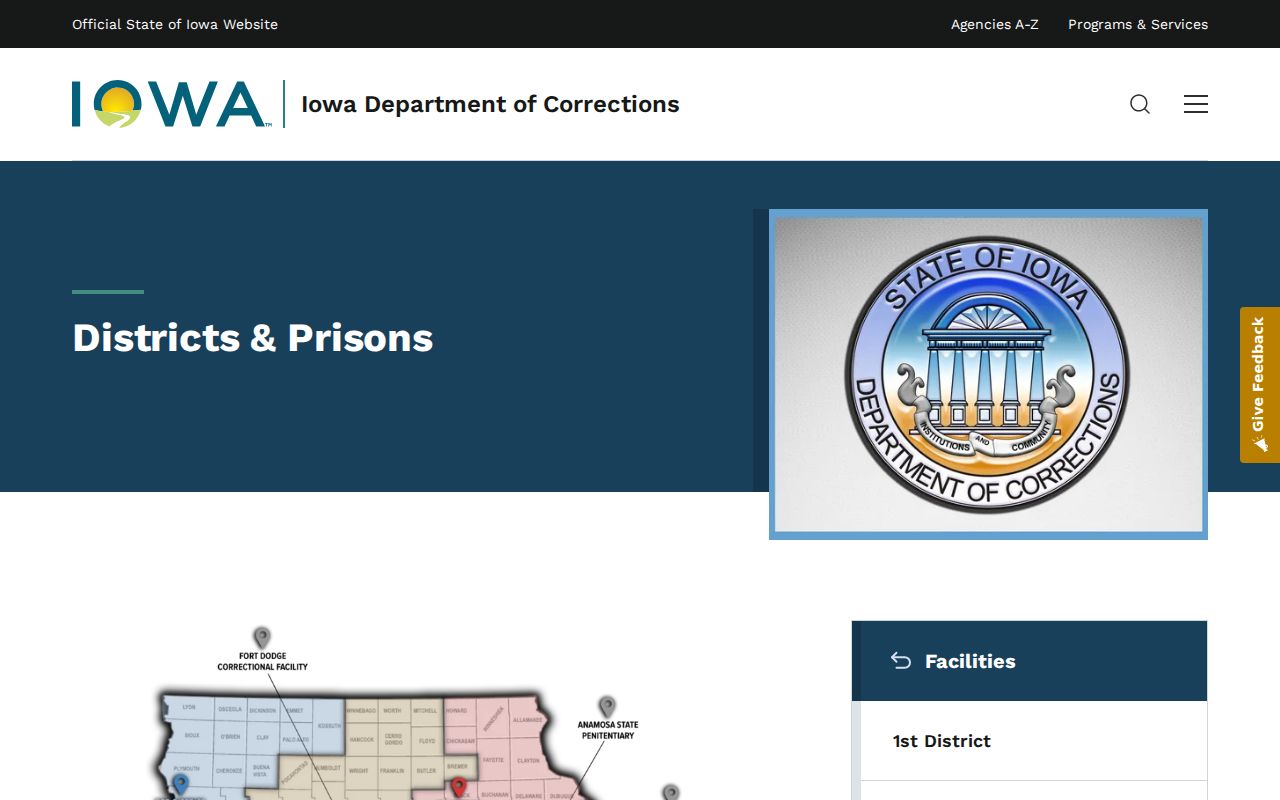
The map also shows why probation and parole records route through judicial-district departments rather than one county probation office in each county.
| Custody Layer | Start Here | Fallback |
|---|---|---|
| County jail | County sheriff roster or booking line | Iowa VINE and county clerk |
| State prison or supervision | Iowa DOC Offender Information | Appropriate correctional district |
| Federal prison | BOP Inmate Locator | Federal district clerk or PACER |
Types of Iowa Criminal Records
The creator determines the best source. City police, sheriffs, troopers, and DCI agents create incident and arrest records. County jails create bookings. County attorneys and the unified Iowa District Court create charging and case records. Iowa DCI creates the state history product from contributed data. Corrections, the parole board, and the registry keep their own status records.
- Arrest and booking records: show an event, intake, booked allegations, bond, and release.
- Criminal court case files: show filed counts, docket activity, orders, outcomes, and sentence.
- Repository histories: group Iowa fingerprint-linked events and reported results around a person.
- Warrant records: sit with the issuing court and law enforcement, with unserved materials restricted.
- Custody and supervision records: track jail, prison, probation, parole, and registration in separate systems.
- Disposition
- The charge-level result, such as conviction, dismissal, acquittal, or deferred judgment.
- Rap sheet
- A person-centered repository summary of arrest cycles and related outcome or custody data.
- Trial information
- Iowa's common prosecutor-filed charging document for an indictable offense.
- SID number
- The state identifier used to link a fingerprint-based Iowa criminal-history record.
Verifying Iowa Warrant Records
Iowa has no complete public statewide warrant list. Judges and magistrates issue arrest, bench, and search warrants, while law-enforcement systems carry operational data. Applications, orders, and supporting material for an unserved warrant are generally kept from public view. A no-result in an online docket therefore is not proof that no warrant exists.
For a known case, check Iowa Courts Online and contact the clerk serving the filing county. For a possible local warrant, contact the relevant sheriff or police agency through an official number. Do not attempt to resolve or test a warrant through an unofficial lookup. If the concern involves your own status, official verification and legal advice are the safer path.
Iowa Public Access Laws
The Iowa Open Records Law starts with a right to examine and copy nonconfidential government records. It does not erase other restrictions. Chapter 692 controls criminal-history dissemination and challenge rights. Court rules govern judicial access, while separate laws protect juvenile cases, intelligence, victim data, personal identifiers, and unserved warrant material.
Key Statutes:
Iowa Code chapter 22 grants access to nonconfidential agency records and permits reasonable production costs.
Iowa Code chapter 692 governs DCI collection, release, redissemination, subject review, and correction.
Iowa Code chapter 901C makes qualifying court cases confidential after an expungement order.
Iowa Code chapter 692A defines the public and official registry information split.
The DPS open-records page shows how that agency receives requests and calculates production costs.
Its fee policy belongs to DPS. Do not assume every Iowa county uses the same terms.
Iowa Supervision and Incident Records
Probation is ordered by a judge. Parole is granted through the Iowa Board of Parole. Eight Judicial District Departments of Correctional Services supervise both across all 99 counties. Court dockets may show the sentence or revocation filing, while Iowa DOC Offender Information may show a public status. Detailed plans, assessments, and presentence reports are restricted.
The Iowa Board of Parole publishes statewide process and decision information.
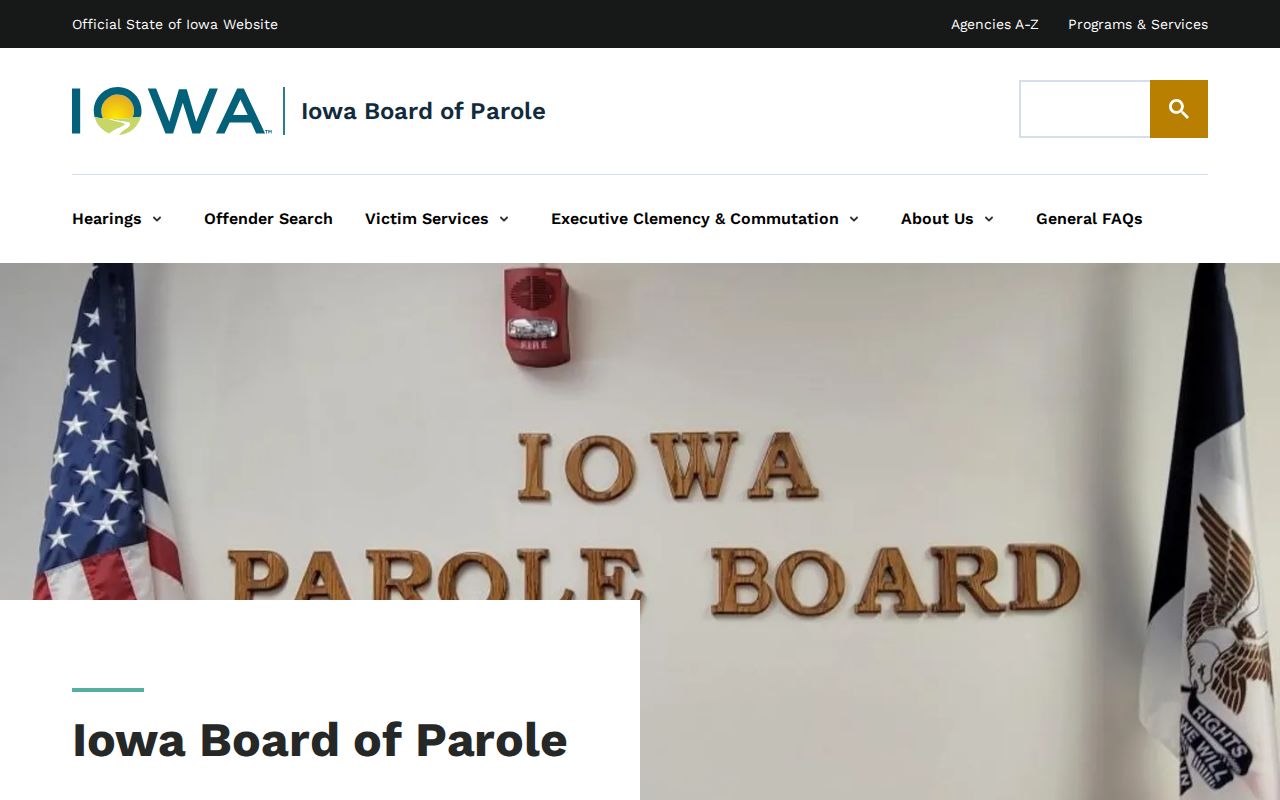
That source answers release-process questions, but current custody should still be checked with Iowa DOC.
Police reports follow the creating agency. A trooper record goes to DPS; a city or sheriff report stays local. The Iowa State Patrol accident report portal is one statewide example.
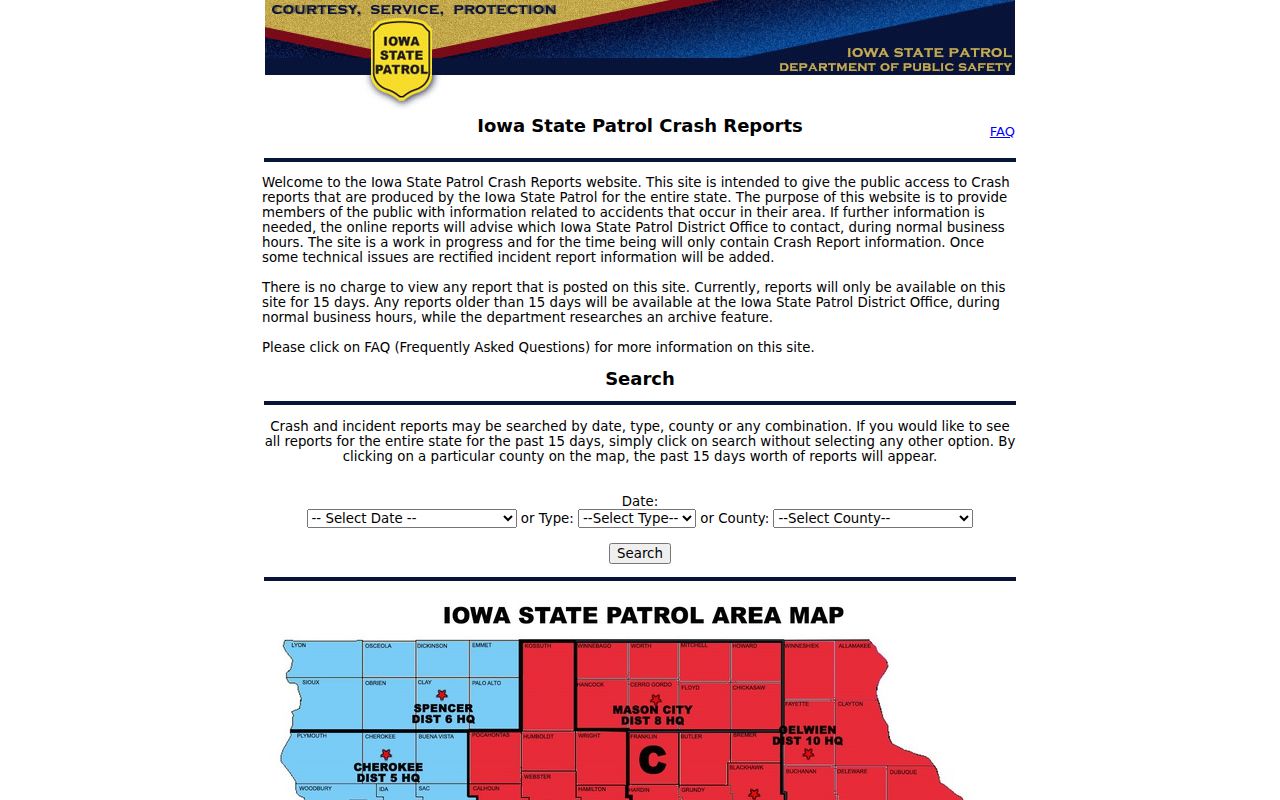
It covers State Patrol reports, not every crash or police incident created within Iowa.
Reading Iowa Record Classifications
Iowa labels felonies Class A through D and misdemeanors aggravated, serious, or simple. The filed class describes the allegation at that stage, not the final result. Enhancements and offense-specific laws can change the sentence, while a charge may later be amended, dismissed, or resolved through another disposition.
Docket prefixes can help orient a search. FE points to felony, AG to aggravated misdemeanor, SR to serious misdemeanor, SM to simple misdemeanor, and OW to OWI. Read the charge statute, disposition, and judgment together. “Disposed” only means the court resolved the item. It does not mean “convicted.”
Note: A case prefix is a navigation aid, not a substitute for the charge-level judgment.
Iowa Criminal Record Fees
The standard DCI name-based history costs $15 per last name. A current and former surname means separate paid requests. Basic Iowa Courts Online docket searching is free, while advanced access, clerk copies, certification, archive work, fingerprint capture, and public-record production can add charges. Ask the custodian for an estimate before ordering a large file.
| Item | Current Rule |
|---|---|
| DCI name check | $15 per last name |
| Iowa Courts Online basic docket | Free public search |
| Advanced court search | $25 monthly subscription |
| Local fingerprint capture | Varies by the capturing agency |
| Chapter 22 request | Reasonable actual production cost; DPS has its own free-hour policy |
DCI's active web intake is staff processed. It is not an instant result database. The form asks for requester contact and payment details, delivery choice, the subject's exact name and birth date, and gender. A middle name and other lawful identifiers can help separate common names. Results may arrive by mail, fax, or encrypted email, depending on the selected route. Telephone requests are not accepted.
Local costs belong to the local custodian. A clerk may charge for pages, certification, supervision, or archive retrieval. Police agencies can charge actual production and redaction costs under chapter 22. Fingerprint-card capture fees and appointment rules also vary by agency. Request a written estimate and identify the precise record, date, place, and case or incident number to reduce unnecessary search time.
Iowa Expungement Record Effects
Iowa expungement makes a qualifying case confidential. It does not promise that every trace in every authorized system is destroyed. Section 901C.2 covers qualifying acquittals and dismissals after statutory conditions are met. Section 901C.3 covers a narrow group of misdemeanor convictions after more than eight years, with exclusions, no pending charges, payment rules, and a general once-in-a-lifetime limit.
The official Iowa expungement code defines those routes.
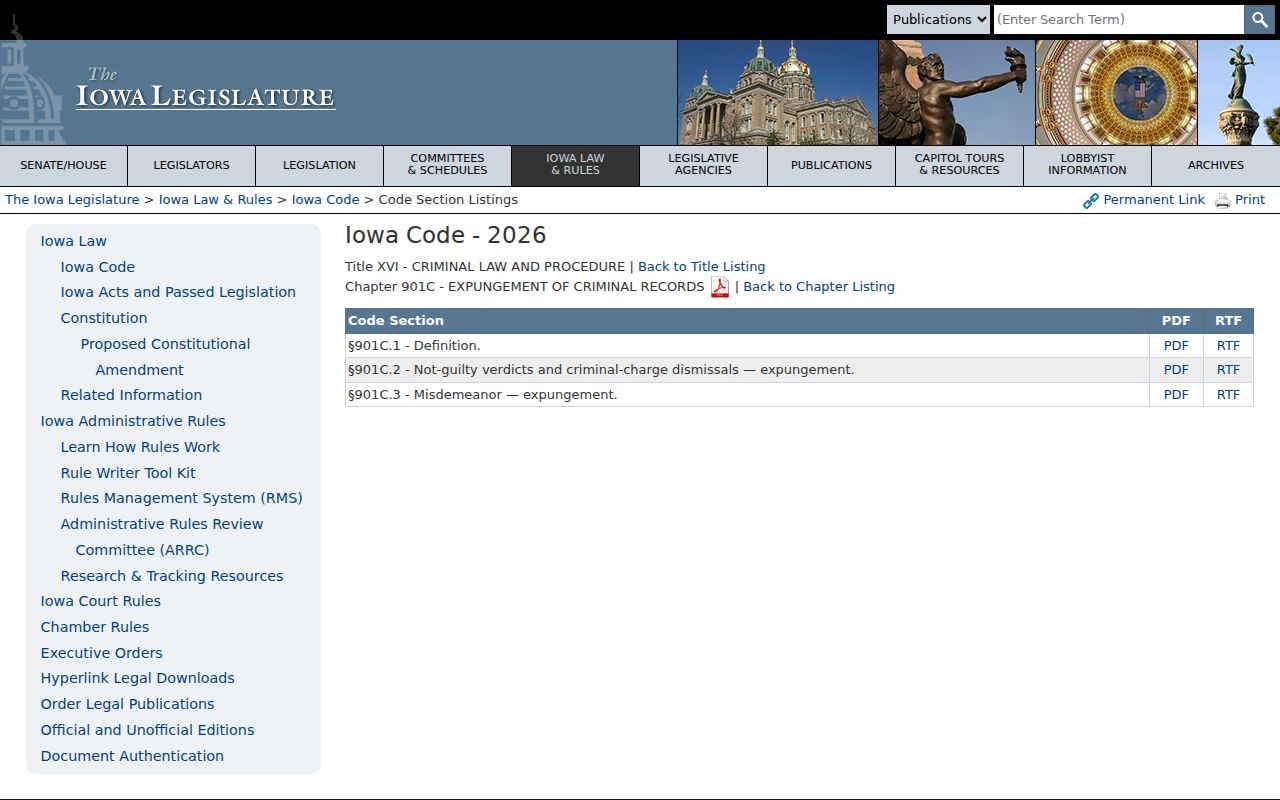
Relief is filed in the Iowa District Court county that holds the case. After an order, check both the public docket and your own DCI record, since the clerk's notice drives qualifying DPS removal.
A deferred judgment uses a different statutory route, and narrow offense-specific laws can apply in other situations. Iowa does not have a broad automatic clean-slate process for ordinary eligible records. Match the exact charge-level result to the correct statute, confirm all required financial obligations, and retain a certified copy of any order. An old cached reference does not make a confidential case public again.
Federal and Historic Iowa Records
Federal records sit outside Iowa DCI and Iowa Courts Online. Iowa is divided between the Northern and Southern Districts. PACER holds federal dockets, the FBI Identity History Summary is the subject-only national fingerprint route, and the BOP locator covers federal custody from 1982 forward.
The Northern District of Iowa provides its federal court and archive routes.
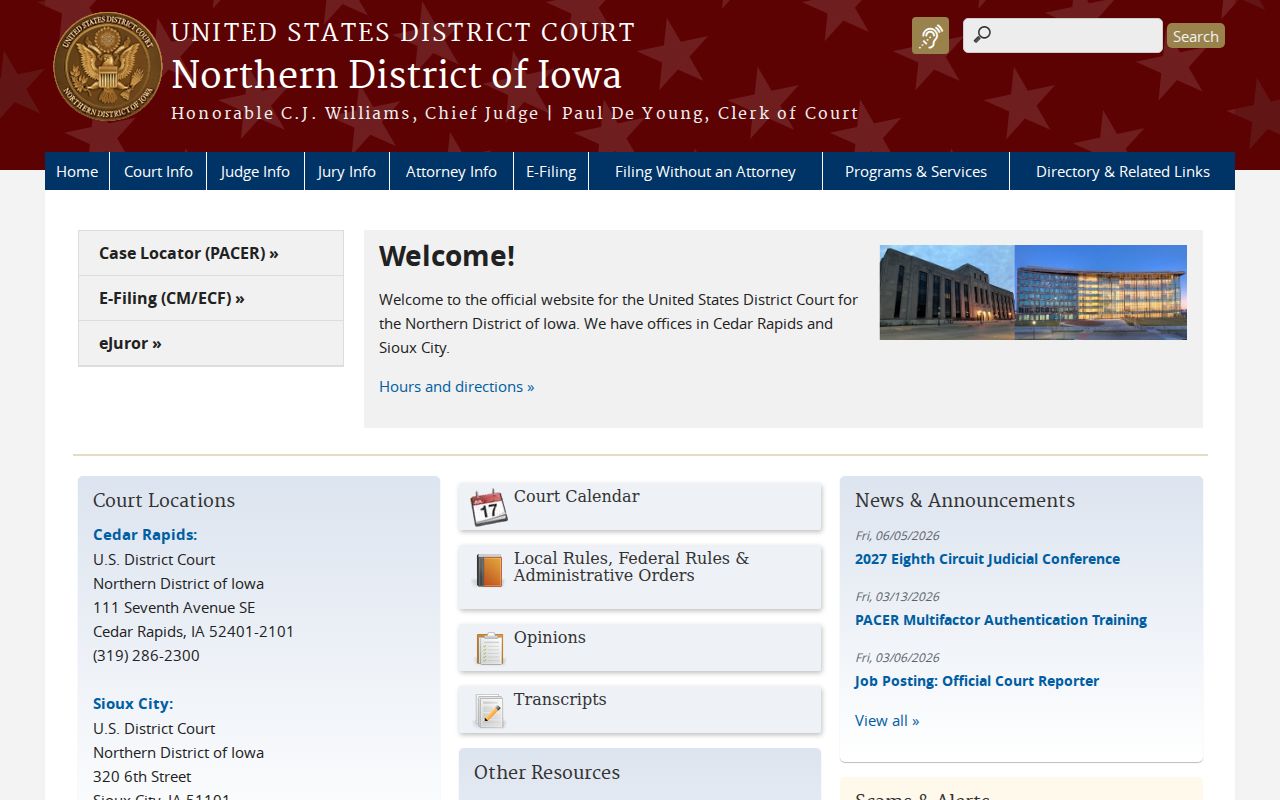
Some older Northern District material was never electronic, and records known as Flood Files were damaged or destroyed in the 2008 Cedar Rapids flood.
The Southern District of Iowa is the other federal trial-court source.
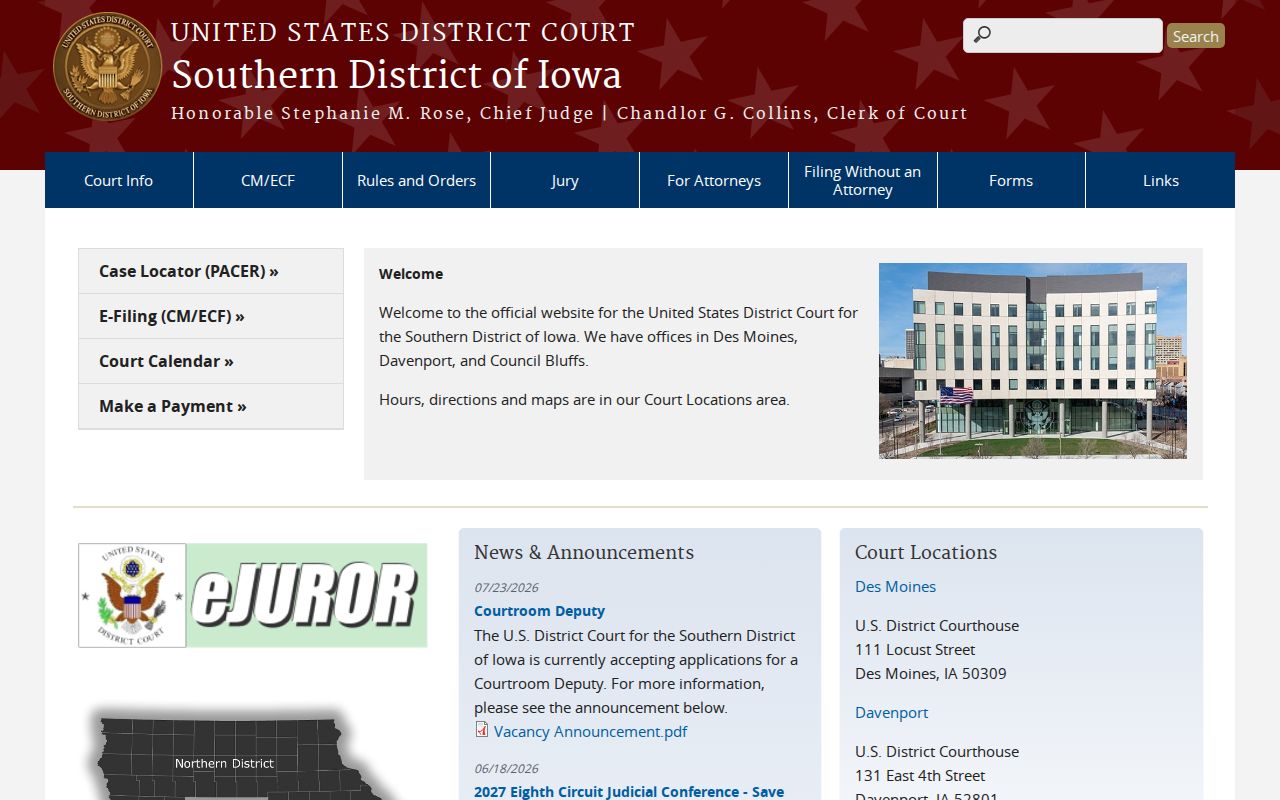
Confirm the correct district and division before requesting a federal document.
Older local records may move to archives. The State Historical Society of Iowa county records collection preserves material from across the state.
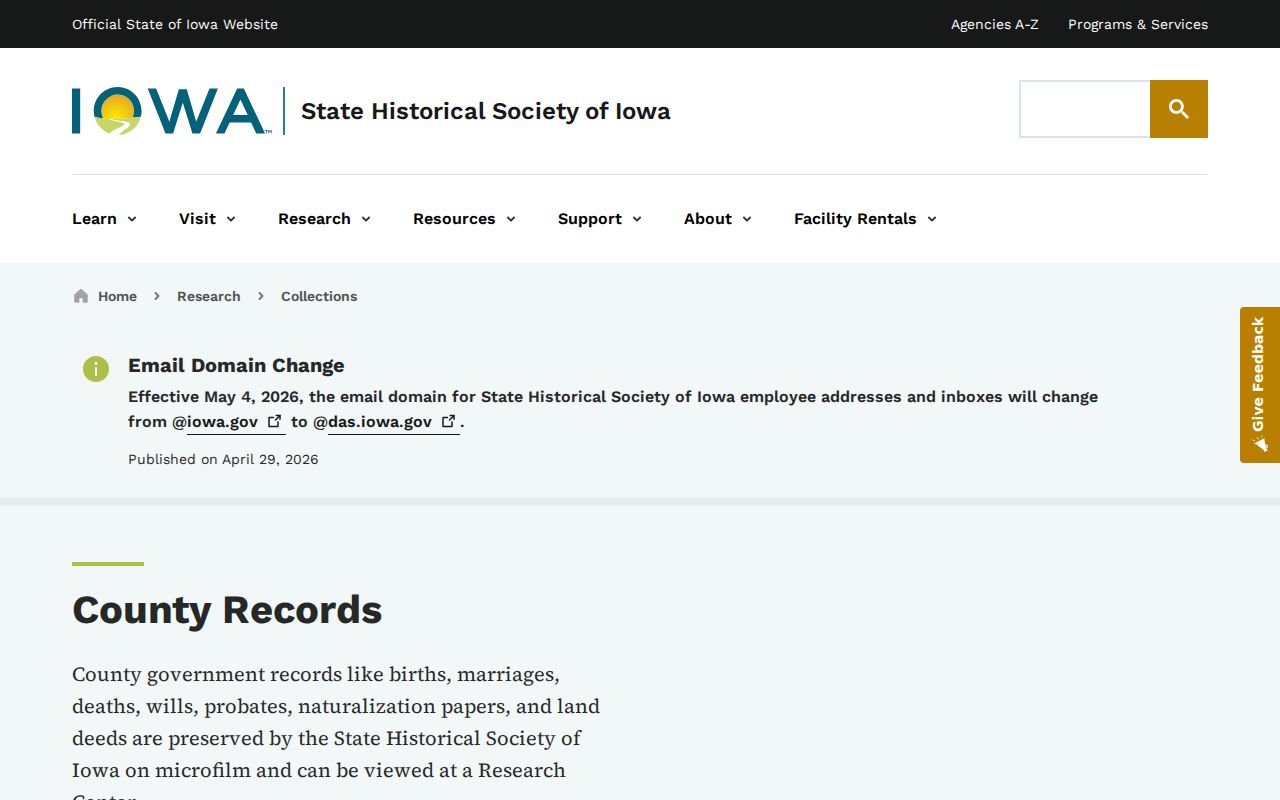
Archive research starts with the county and record series, while modern certified case copies still come from the filing clerk.
Criminal Records by County in Iowa
County routing is essential because arrests, jail bookings, incident reports, and source court files are local records. The largest Iowa systems handle high volumes, but the custodian rule is the same statewide. Use the place of arrest, booking, or filing to choose the correct county site.
Polk County
Des Moines · Largest metro court and sheriff system
Linn County
Cedar Rapids · Major eastern Iowa record hub
Scott County
Davenport · Quad Cities court and custody hub
Johnson County
Iowa City · University and metro record systems
Black Hawk County
Waterloo · Major northeast Iowa court system
Dallas County
Adel · Fast-growing metro county
Woodbury County
Sioux City · State and federal court center
Story County
Nevada · Ames-area local record routing
Browse the full directory of all 99 Iowa counties to open the criminal records site for any county.